
ARTICLE AD BOX
On lakes across Minnesota, it’s common to see shorelines buffered with boulders, often stretching hundreds of feet across and several feet deep.
These barricades of large rocks, known as riprap, are designed to keep soil from crumbling into the lake due to waves or high water. For many home or cabin owners, riprap also creates a neat, aesthetically pleasing shoreline, a status symbol for up-north lake life.
But armoring lakeshores comes with an environmental cost. Rocks may stop erosion, but they’re also hard and unyielding. They don’t offer habitat for fish, turtles, birds or pollinators.
And they don’t slow water running off the landscape, which can carry nutrients from lawn fertilizers that are harmful to lakes. Those nutrients, like phosphorus, pollute the water and fuel algae blooms.
“If one pound of phosphorus ends up in a lake, it creates 500 pounds of algae. And nobody wants to boat, recreate or do anything in a swamp of algae,” said Jarrett Drileck, a shoreline technician with the Crow Wing Soil and Water Conservation District.
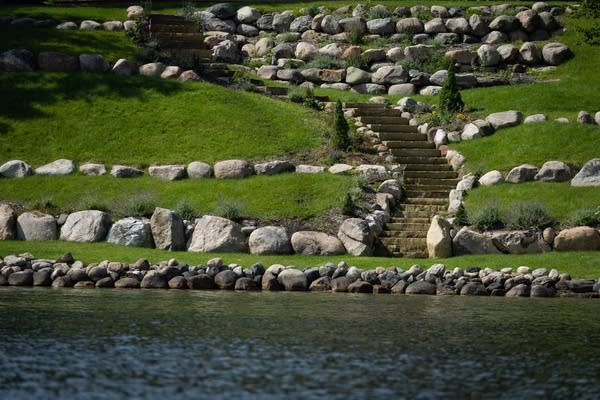
Rocks also absorb heat from the sun and can warm up water as it runs into the lake. That creates better conditions for algae blooms.
Homeowners may often have good intentions when they buffer their shorelines with rocks. Eroding shorelines are a real concern, especially for homeowners worried about losing their valuable lake property.
Climate change is causing more extreme rainfalls, fluctuating lake levels and expanding ice heaves that push onto land. Recreational boats are bigger and more powerful, sending large waves crashing into shore.
Sometimes, rock riprap is the only last-ditch fix to save a collapsing shoreline.
But scientists say it’s often the case that erosion could have been prevented in the first place by avoiding a manicured lawn and keeping the lakeshore more natural, with a buffer of trees and deep-rooted plants along the water’s edge.
And many experts argue that erosion is often misidentified and misunderstood, and many riprap projects are unwarranted or overbuilt.
“There’s a lot of places where riprap just isn’t necessary and isn’t needed yet,” said Jake Frie, an area hydrologist with the Minnesota Department of Natural Resources for Crow Wing and Aitkin counties.
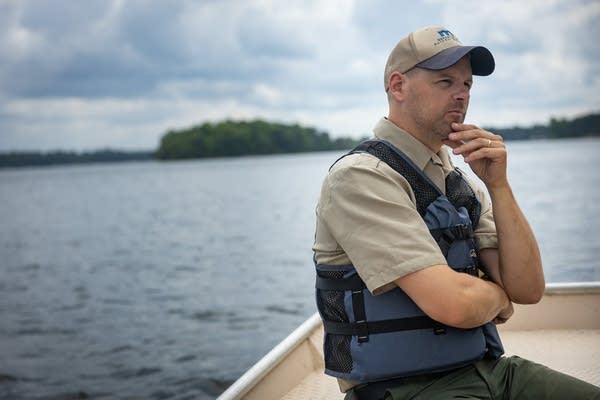
The state's public waters rules allow riprap without a permit if there’s a “demonstrated need” due to erosion. But state and local regulators have been shifting their approach from green-lighting to pumping the brakes on riprap projects.
That’s a change from the past, when the DNR often recommended riprap to solve erosion problems.
They now hope to convince more landowners to use natural materials and native plants to restore and protect their lakeshore before resorting to rock. Those natural solutions can also be more cost-effective.
“We don’t want to see any erosion of shorelines. We want to protect our shorelines,” Frie said. “But we want to make sure that when we have riprap, it’s placed in the right location at the right time.”
Is it really erosion?
On Cross Lake, part of the Whitefish Chain of Lakes about an hour north of Brainerd, there’s still plenty of wild, woodsy shoreline, including a federal recreation area.
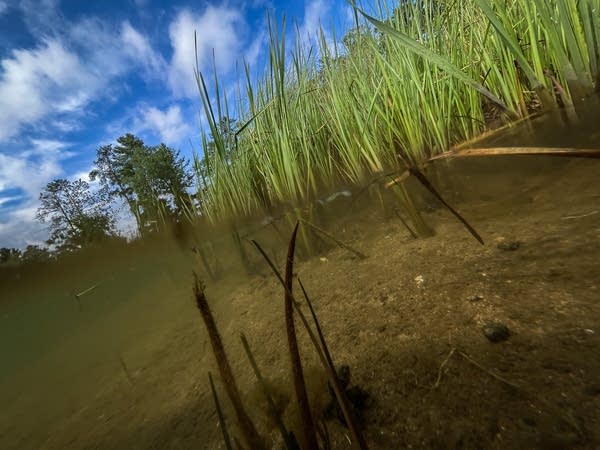
The trees and vegetation along the water’s edge provide habitat for fish, frogs and insects. They also help prevent waves from damaging the shoreline, Frie said.

“We know these types of shorelines benefit our ecosystem and our water quality the best,” he said.
The DNR estimates that nearly half of Minnesota’s natural shorelines have disappeared as property owners cleared trees and vegetation for a manicured lawn, better view of the lake or a tidy rock-lined edge along the water. The agency estimates the loss continues at a rate of 1 to 2 percent per year.
Many small lakes still have natural shorelines. But large lakes such as those in the Whitefish chain usually see more intense development and recreational use, like boating. That often leads to more efforts to “armor” the shoreline to try and protect it, Frie said.
Some landowners see signs of natural, normal erosion and assume they need to take immediate action, but that’s not always the case, Frie said. He pointed out a spot on Cross Lake where waves had carved out the underside of a bank, exposing tree roots.
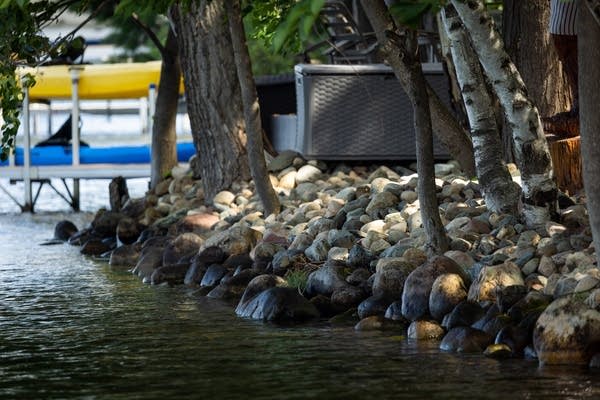
“Folks are looking at that and saying, ‘That’s erosion. This is a problem. I think I’m losing my shoreline. We need to go right to riprap,’” Frie said.
However, the shoreline is stable and won’t continue to crumble, he said. Deep-rooted plants and trees are holding it in place, and the undercut bank is providing habitat for small creatures and fish.
“This is natural erosion that’s going to happen on a lot of our shorelines,” Frie said. “This is not a ‘stop everything.’”
But there are times when riprap is the best solution to prevent further damage to lakeshore, Frie said.
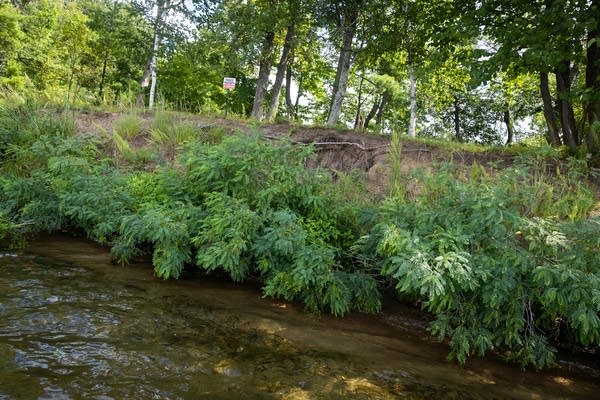
On a point on Lower Whitefish Lake battered year-round by wind, waves and ice heaves, he pointed out a sandy hillside crumbling into the lake. The landowners tried using a natural restoration method, but it didn’t work.
It’s an example of a location where riprap is warranted to stabilize the bank, Frie said. But the rocks will extend only a couple of feet above the water, and the landowners plan to plant a buffer of plants and trees above them, he said.
Property owners can call their area DNR hydrologist to get advice about how to deal with their shoreline and find out whether there’s actually erosion happening, Frie said.
“We hope that by educating people about the benefits of natural shorelines — and that there are probably fewer places for riprap than we think — that is going to create the change we're looking for,” Frie said.
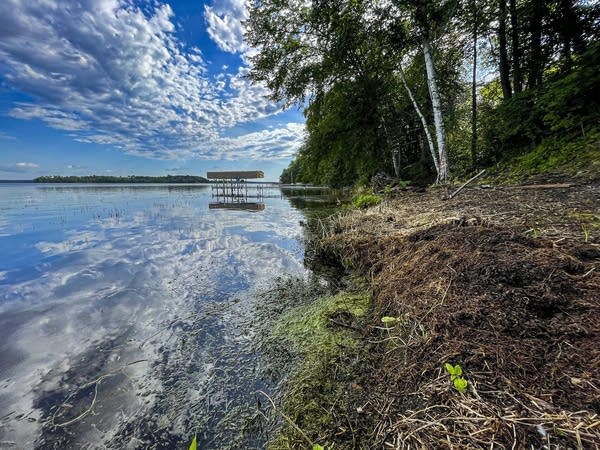
Willow wattles and soil burritos: natural solutions
Homeowners Mark and Karen Leigh wanted to do something to protect their steep hillside and shoreline on Upper Whitefish Lake. But they wanted a more eco-friendly solution than riprap.
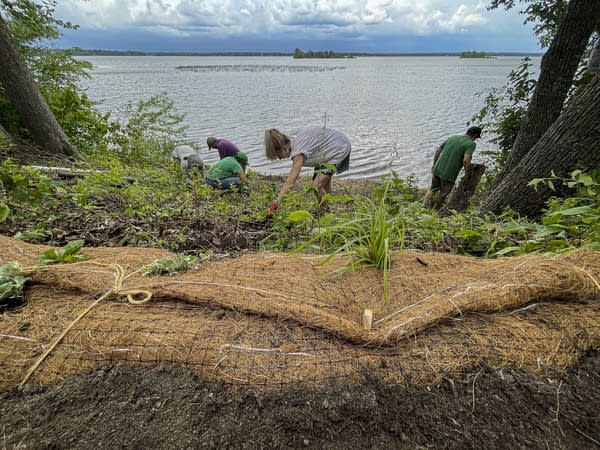
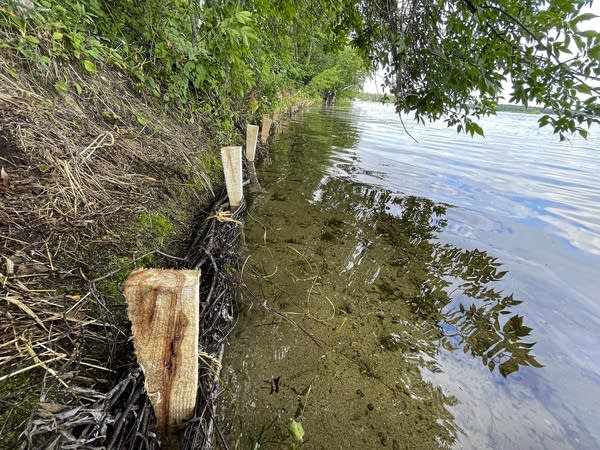
Last month, a group of volunteers helped restore the Leighs’ lakeshore as part of a community build project. They bundled hundreds of dried willow branches and tied them with twine, creating a natural fence called a wattle.
The volunteers snaked the willow wattle down to the lake, stretched it along the shoreline and pounded stakes to hold it in place.
Then, they planted nearly a thousand deep-rooted native plant seedlings on the hill and along the water’s edge.
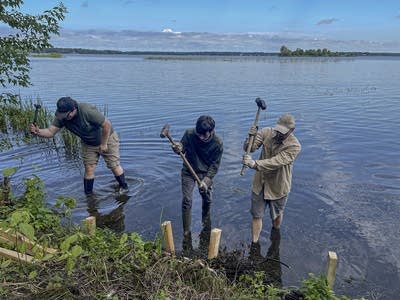
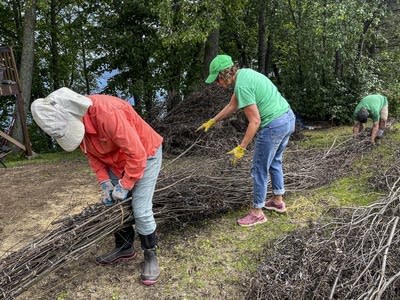
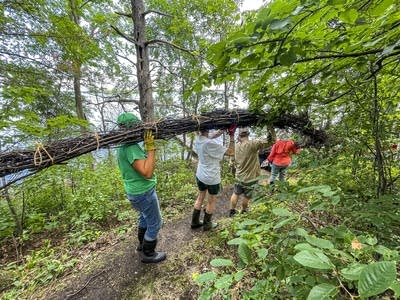
The willow wattle will help protect the new plants, “so if there’s a lot of waves, they don’t just float and go away,” said Laura Mendoza, owner of Great Roots, an Aitkin-based ecological restoration company that focuses on natural shorelines.
“It will also break down the energy of the waves,” Mendoza said.
At the top of the hill, the volunteers dug a trench. Using coconut fiber, they created a “soil burrito” and filled it with compost and more native plants. It will act as a speed bump to slow water running down into the lake, Mendoza said.
The project should stop erosion and prevent more dirt from washing into the lake, carrying with it phosphorus and other nutrients, said Drileck with the Crow Wing Soil and Water Conservation District.
The soil and water conservation district paid half of the cost of the Leighs’ project, which totaled about $7,000 — much less expensive than riprap, Drileck said.
The Whitefish Area Property Owners Association has been trying to promote more natural restorations to help landowners who have lost shoreline due to erosion and wave action, and to reduce phosphorus levels in the lakes.
“I think we’re seeing more and more and more people starting to go this direction,” said Kristie Roedl, the association’s shoreline restoration director.
Four weeks after the project was finished, the Leighs said they were happy with the natural look of the lakeshore.
The plants along the lakeshore had begun to fill in, and a single black-eyed Susan bloomed.
The couple had spotted ducks and fish hanging out near the willow wattle.
“At some point, we as Minnesotans have to realize what we have, and learn to take care of it better,” Mark Leigh said. “We're building homes and have a lot of nice toys. But I think the shoreland is a lot nicer if it's natural.”
Public resistance
Despite the environmental benefits, not everyone is convinced that natural shorelines are the best option. Realty ads and up-north magazines frequently feature luxury lake homes with tidy rock-lined shores or sandy beaches, with little if any vegetation.
Landowners tend to rely on advice from landscape contractors who may specialize in riprap rather than natural shorelines.
The Forest Lake-based company Lakeshore Guys does shoreline work in Minnesota and several other states. Joe Palumbo, the company’s president, said he suggests natural solutions to property owners where he thinks it would work.

But most people don’t want a natural lakeshore because they think it looks weedy or unkept, Palumbo said.
“We just want to protect the shoreline. That’s the business we’re in,” he said. “But we can’t change public opinion.”
Palumbo also thinks natural or bioengineered shorelines don’t work in places where the water is too deep, the lake bottom is too sandy or in places with strong wind or boat waves. He disagrees with DNR or local officials who have told him the choice is a bioengineered shoreline or nothing.
“Then what happens is the shoreline continues to erode, and erosion into the lake is horrible,” Palumbo said. A better choice is a hybrid approach with some riprap and some natural shoreline, he said.
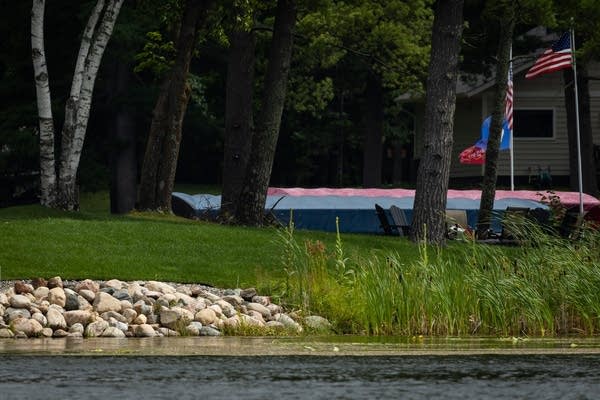
Advocates of natural, vegetated shorelines say they can still look neat and well maintained. They say it’s possible to find a balanced approach that allows the homeowners to enjoy the lake, but still protect the shoreline.
Regulators prefer carrots to sticks
The DNR and local conservation officials are trying to spread the word to property owners about alternatives to riprap that are more beneficial to lakes.
State rules and sometimes local ordinances regulate how riprap can be installed, including how far along the shore and how high and steeply it can extend above the water line. Rocks that aren’t placed properly can slide into the water or get pushed up onto shore by ice heaves.
Before installing rock, property owners should call their local planning and zoning official to find out if their city or county requires a permit for riprap projects, or they could risk a fine or enforcement action. More than half of counties do, although their rules vary.
For their part, DNR officials will use county assessor’s photos and aerial images to investigate potential violations, Frie said. Occasionally, the agency will require a property owner to remove illegal riprap.
“The fine doesn’t move the needle. People will pay the fine,” Frie said. However, having to pay for removal and restoration “can get expensive,” he said.
The DNR has no imminent plans to change state rules to add a permit requirement for all riprap projects.
Instead, the agency is working to help property owners, landscape contractors, local government officials and even its own staff better understand what erosion is — and when riprap is actually necessary.
“We want to be helpful in getting folks the help they need to protect their shoreline,” Frie said. “But also to provide good water quality and good habitat.”


 English (US) ·