
ARTICLE AD BOX
Minnesota's burgeoning clean energy industry is trying to figure out a new path forward in the wake of the massive federal budget bill President Donald Trump signed on July 4, which eliminates tax credits for small and large-scale wind and solar projects.
Fields of wind turbines and large solar installations have sprouted around the state in recent years, driven by plummeting costs for the green technology and a state law requiring utilities to produce 100 percent of their electricity from carbon-free sources by 2040.
Meanwhile, thousands of homes, farms and businesses have also installed smaller solar projects on rooftops and in fields to produce their own electricity, often selling excess power back to utilities.
Just last year Minnesota added nearly 400 megawatts of new solar energy capacity, according to an annual report on the state’s sustainable energy growth. That's enough to power more than 60,000 homes.

Those projects all benefited from federal tax credits that shaved 30 percent or more off their cost. But those credits are all being phased out by the ‘Big, beautiful bill’ that Congress passed and President Trump signed into law last week.
Republicans slashed those credits and a host of other green energy incentives to help pay for their tax cuts. Some also argued that wind and solar are mature industries that no longer need subsidies.
Clean energy advocates argue eliminating green energy incentives tilts the playing field in favor of fossil fuels, such as coal, oil and gas — which they point out also receive tax subsidies.
“This bill is definitely a setback for Minnesota's energy future and the nation's global economic competitiveness,” said Gregg Mast, executive director of Clean Energy Minnesota, which represents more than 60 clean energy companies statewide.
Experts agree that plenty of additional solar and wind projects will continue to be built in the coming decade, both residential, rooftop projects and large-scale utility farms.
“Even without the tax credits, if you're going to build new (power) generation, and you're really paying attention to just what it costs, you're still going to build wind and solar,” said Pete Wyckoff, Deputy Commissioner of Energy Resources for the Minnesota Department of Commerce.
“But you're probably going to do it slower, because your budget for doing such things only goes so far.”
From rooftops to wind farms
The federal budget bill eliminates tax credits both for large, utility-scale wind and solar farms, and for much smaller projects that homeowners or businesses install to defray electric costs.
But the tax credits are phased out on different timelines, depending on the size of the project.
Hardest-hit are small-scale, residential projects. The 30 percent tax credit for those projects expires by the end of this year.
That credit provides a big incentive for homeowners to invest in solar. According to the IRS, that tax credit saved nearly 9,000 Minnesota households about $57 million last year. Eliminating it may have a huge impact on solar installers.
“Our industry employs just over 5,000 Minnesotans throughout the state, and we're thinking 70 percent of those jobs are at risk of being eliminated right now,” said Logan O'Grady, Executive Director of the Minnesota Solar Energy Industries Association.
The tax credit will be phased out more gradually for larger, commercial solar projects. Businesses have until the end of 2027 to place those projects in service.
Griffin Dooling, CEO of Blue Horizon Energy, which installs commercial solar projects across the state, said he's expecting customers to rush to install solar before the credit expires.
“At the end of the day, the federal government's not outlawing solar, right? They're just making it more expensive by taking away some of these incentives. So over the next couple of years the main sort of focus is going to be making sure that we help folks take and utilize these incentives while they're still in play,” said Dooling.
Dooling expects larger companies to still invest in solar, even when the credit expires. But he says it will especially hurt smaller businesses that needed the credit to make the investment financially feasible.
In addition, the new tax law is expected to raise the price of electricity in the state.
That's because tax incentives that companies have used to build large-scale wind and solar projects around Minnesota are also being phased out by the bill. Utilities such as Xcel are investing in those projects because wind and solar projects are now cheaper to build than fossil fuel plants.
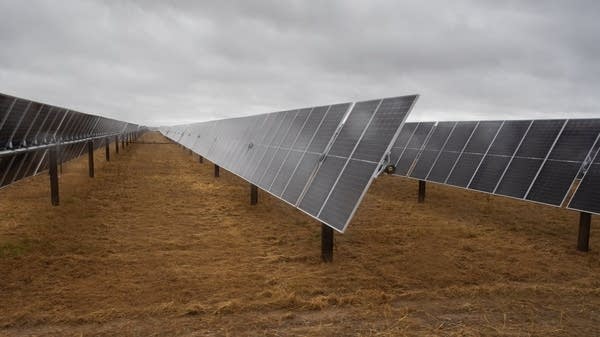
Those projects are also necessary to help utilities comply with a recently passed state law that requires them to produce all their electricity from carbon-free sources by 2040.
Without the federal tax credits, those projects will cost 30 to 40 percent more to build, said Wyckoff. And utilities can’t quickly pivot to natural gas even if they wanted to, he said. Because of supply chain backups, there’s at least a five-year wait time to build a natural gas-fired power plant.
“The only thing we are really set up to build this decade as our demand for electricity goes up in terms of new generation, are wind and solar and battery storage,” said Wyckoff.
Since utilities will have to pay more to purchase renewable electricity, those higher costs will likely get passed on to customers. Wyckoff said electric rates in the state are expected to increase by at least 10 percent over the next 10 years.
Energy Innovation, a clean energy think tank, projects an even larger increase. The group estimates Minnesota ratepayers will pay an additional $7 billion in increased electric bills by 2035.
That’s concerning to ratepayer advocates, who point out that many Minnesota residents already are struggling to pay their energy bills.
“At the end of March, Minnesota households owed a total of nearly $150 million in past due utility bills, and that figure has nearly doubled over the past five years,” said Annie Levenson-Falk, executive director of the Citizens Utility Board of Minnesota.

But others caution that any rate hikes first need to be approved by the state’s Public Utilities Commission.
“Minnesota has a highly regulated electric industry, and so the PUC has a lot of say in what will actually happen to the cost of electricity here in Minnesota,” said Michelle Benson, policy director for energy at the Minnesota Chamber of Commerce.
Benson said because of Minnesota’s 100 percent carbon-free electricity law, she expects the demand for renewable energy to remain robust in the state, despite the loss of the tax credits.
What’s frustrating for renewable energy proponents is that energy efficiency and renewable energy tax incentives are being eliminated at a time when demand for electricity from data centers and other industries is expected to soar.
“It's going to be harder to achieve American energy dominance when you intentionally hinder critical resources like energy efficiency, wind and solar from the resource mix,” said Gregg Mast of Clean Energy Minnesota.
And it is rewarding the most expensive legacy sources, like coal, oil and gas, and these are all energy sources that don't exist in Minnesota, and we are having to import that energy from out of state," Mast added.
He said a smarter strategy is to invest in the wind and solar that we already have right here in Minnesota.



 English (US) ·