
ARTICLE AD BOX
When Jordan Hinrichs was pregnant with her son Jerrick, she had a feeling something wasn’t right.
Her body wasn’t growing how it was supposed to, and an anatomy scan near the end of her pregnancy showed that her son had a heart defect, so the western Wisconsin family transitioned their care to the Twin Cities. After he was born, Jerrick spent 21 days in the NICU at Children’s Minnesota, and Jordan and her husband noticed that parts of his body looked different than normal.
Before his second birthday, Hinrichs, 32, said Children’s had diagnosed her son with a litany of conditions as they tried to figure out what was wrong: congenital differences like a foot malformation, short legs with little muscle tone and a narrow airway.
“It was literally a roller coaster," Hinrichs said. “One appointment would, all of a sudden, lead into, ‘Well, this is wrong, and I need you to follow up with this specialist.’ And before we knew it, we had multiple specialists involved. We were not getting an answer. We were just getting medical diagnoses. It kept spiraling.”
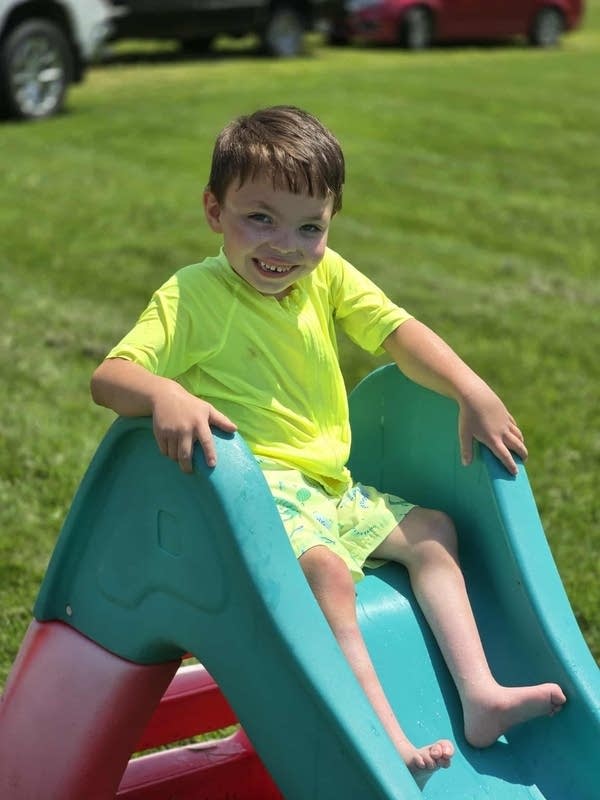
Children’s had Jerrick’s entire exome — the part of the genome responsible for coding genes — sequenced when he was almost 3 years old to identify any gene mutations, but nothing came back to explain Jerrick’s conditions. However, on reanalysis about a year and a half later, the Hinrichs got their answer.
Beau Crabb, a genetic counselor at Children’s Minnesota, said cases like Jerrick’s are referred to as a “diagnostic odyssey.” And with these complicated cases, reanalysis is crucial.
“Genetic testing is a single point in time,” Crabb said. “If we get a negative test result, I don't call families and say, ‘This test is negative, it's not genetic. We'll never see you again.’ We’re always learning more about genetics, and sometimes there are new discoveries.”
This was the case for Jerrick. Crabb said that less than a year after his family got the negative test result, a new paper came out describing 14 individuals with a gene mutation with similar symptoms. One of the labs Children’s works with, Ambry Genetics, had been reviewing the medical literature and reissued the test.
The team discovered that Jerrick had a rare disease called ZMYM2-related syndrome, caused by a mutation in the ZMYM2 protein.
“It was shocking,” Hinrichs recalled. “I think I cried. It was a big relief, like, I'm not crazy. And then on top of it, without having that diagnosis, as a mom, you have that guilt of, what did I do to cause this? So it kind of gave me that closure of this is not my fault.”
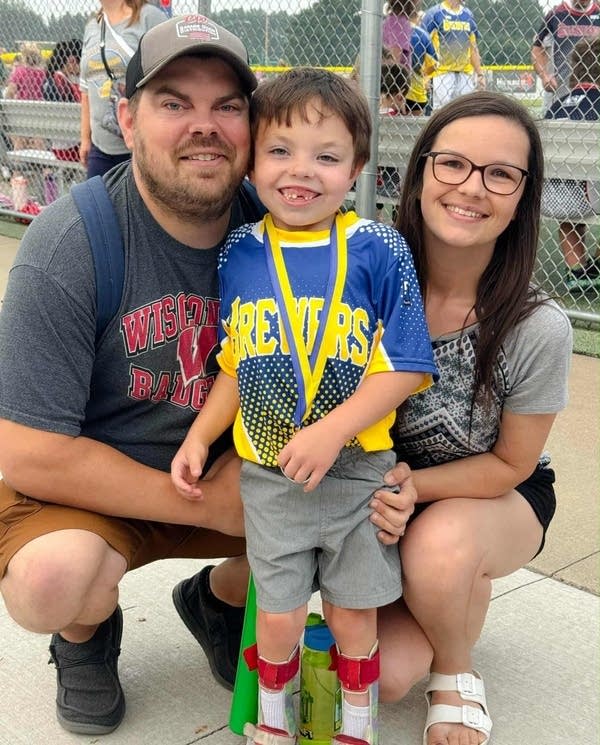
This discovery was made through Ambry Genetics’ Patient for Life program, where researchers proactively and continuously scour medical literature for newly identified gene-disease relationships, according to Michelle Thaler, a spokesperson for the lab. She said they also update past clinical reports as new discoveries are made.
Thaler said this is particularly relevant as 100 new gene-disease relationships like Jerrick’s are identified each year. A study published by the lab this year found that 5 percent of initially negative results like Jerrick’s eventually led to correct diagnosis through this reanalysis.
Jerrick’s treatment plan won’t change much, but Crabb said the diagnosis helps give his medical team — and the family — a roadmap. They can compare treatment plans with what other families are doing with the same diagnosis. It can also give them a better sense of what to expect in the future as Jerrick gets older.
Now 7 years old, Hinrichs said Jerrick is doing phenomenally.
“He is thriving in his own way," Hinrichs said. “He does still face many medical challenges, but he is very, very resilient. He's always happy. He's very joyful. He's full of life. His bravery, his strength – it keeps me whole.”
Hinrichs said that Jerrick’s diagnosis is very rare — he’s one of only about 20 in the world — but the diagnosis itself has opened up a door to a community of families caring for those with other rare diseases.
Hinrichs said she hopes her experience can help other families searching for a medical diagnosis.
“Don’t give up,” she said. “If you are feeling that there’s something there, your gut is most likely right. Just be patient and continue to fight for an answer.”


 English (US) ·