
ARTICLE AD BOX
Hundreds of people stood in a long line that snaked outside the offices of Mesabi Metallics in Nashwauk last week, eagerly awaiting the chance to get an up-close look at the largest mining trucks ever to rumble through the mines on Minnesota’s Iron Range.
They boarded buses and rode past giant buildings under construction at the mine site. Then, on mud stained red by iron ore, they stood and gaped at one of the mine’s new haul trucks, part of $110 million in new equipment purchased in anticipation of the mine’s opening next year.
"It's an amazing piece of equipment,” gushed Jake Schmidt, who drove from Tower to see the bright yellow Komatsu truck, the size of a two-story house.
"It's a real engineering feat to get that thing built in here and reassembled and going again,” he marveled.
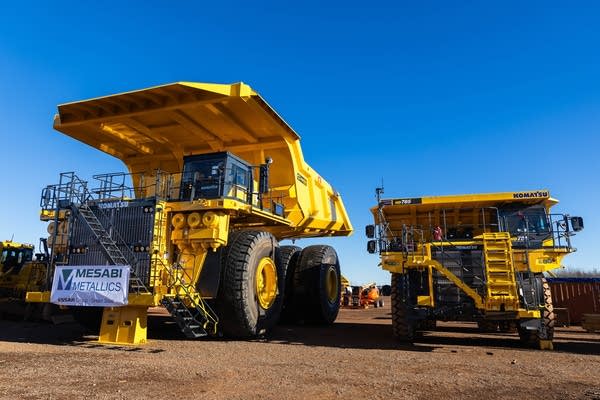
Nearby, Larry Lanska of Virginia said it makes older mine trucks, like the ones he used to drive in the 1980s, look like toys.
"I used to work in the mines, but this is a whole different scale,” he said.
People posing for pictures were eclipsed by a single, 13-foot tall tire. The truck can haul 400 tons of rock and ore out of the mine in a single load. That's nearly twice as much as the trucks used at other mines on the Range.
It’s not just their sheer size that sets them apart. The trucks can run on electricity, which reduces pollution and is more efficient than diesel.
And, they’re designed to be operated autonomously — without drivers — as they travel back and forth within the mine, hauling loads of giant rocks from the mine pit to buildings where the ore will be crushed down into smaller pieces, the first stage in the process that transforms the ore into taconite pellets that are shipped elsewhere to make steel.
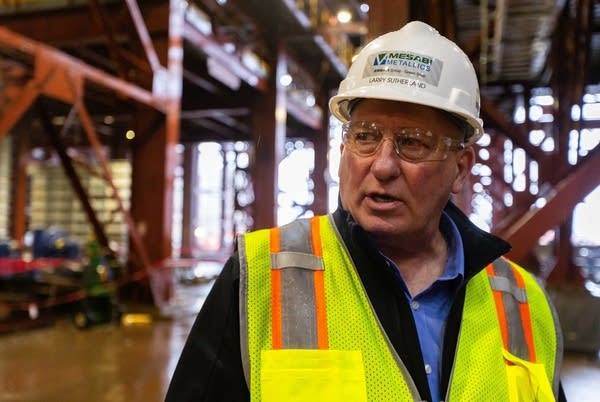
“But it's not about replacing a job with that autonomy,” stresses Larry Sutherland, Mesabi Metallics president and chief operating officer.
Rather, said Sutherland, it’s about building a mine that operates as efficiently as possible, to compete in a global marketplace against low-cost iron ore produced in Australia and Brazil.
“It’s about the efficient scheduling of that expensive piece of equipment and keeping our mine operating 24-7.”
Driverless trucks
If Mesabi Metallics opens as planned next summer, it will be the state’s first new iron ore mine in 50 years, digging up and processing some of the richest ore left on Minnesota’s Iron Range.
The project has moved forward in fits and starts for the past 15 years, bogged down by an economic recession, the parent company’s bankruptcy, missed payments to contractors and the state, and battles over mineral leases.
But in the past couple of years construction has ramped up again, and optimism in neighboring communities is running high over the $2.5 billion project, which Sutherland says is on track to open next June.
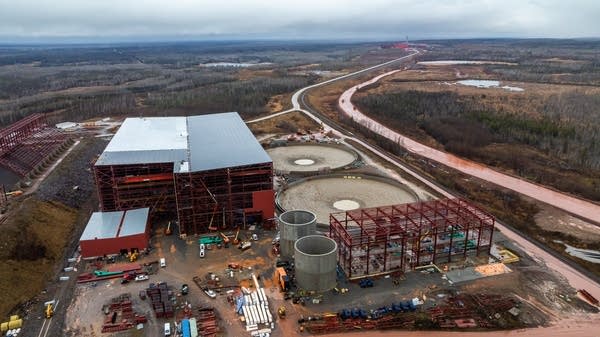
The mine will produce a higher-grade iron ore pellet designed to help feed electric arc furnaces. Those are smaller, more efficient steel mills that are increasingly replacing the giant blast furnaces around the Great Lakes.
Everything at the mine, from its infrastructure to the giant equipment shop to the openings in the buildings where the ore will be crushed, has been designed and constructed to accommodate the behemoth new trucks.
"We're set up from day one to utilize this large mining equipment, which gives us that efficiency of operation," said Sutherland.
The mine haul roads will be lined with electric trolley lines that the trucks can connect to, in lieu of burning diesel fuel. That reduces emissions and also enables trucks to travel twice as fast when climbing steep hills out of the mine pits.
And eventually, these trucks won't need drivers. When operated autonomously, they can be used 24-7, without shift changes or bathroom breaks. Data is constantly monitored to reduce maintenance and fuel costs.
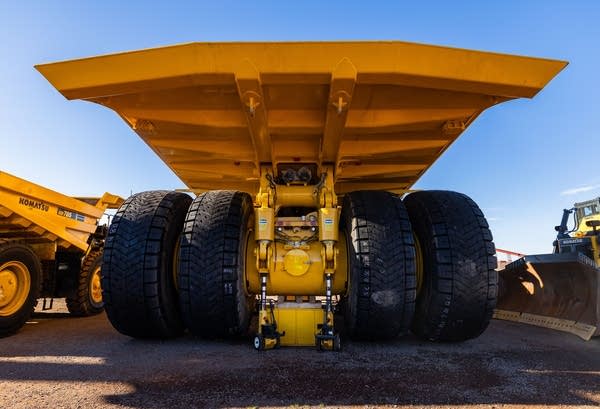
But most importantly, said Sutherland, operating autonomously improves safety. Each truck is equipped with a system of sensors and communication networks to navigate the mine.
If anything gets in the truck’s way, “it will automatically shut this piece of equipment down,” said Sutherland. He said as well as drivers perform at their jobs, “It's human nature. Sometimes mistakes happen.”
Elsewhere on the Iron Range, U.S. Steel has installed technology in its trucks that detect when a driver gets distracted or nods asleep, and responds by sounding an alarm and vibrating the seat.
Autonomous mine trucks were first tested in remote iron ore mines in western Australia in 2008. Now there are nearly 4,000 in use around the world, more than half of them in China. And that trend is expected to continue, especially in new mines like Mesabi Metallics.
"If you have a newly designed mine, you would definitely go for an autonomous one,” said Sebnem Düzgün, a mining engineering professor at the Colorado School of Mines. “It has way more advantages than the current systems."
She said it's more difficult to convert existing facilities, especially underground mines, to autonomous systems. But in general they have been found to improve safety, lower costs and increase productivity.

And while there's often concern about job losses as the industry is increasingly automated, she said so far that hasn’t occurred.
"The practice in the world shows that it doesn't reduce jobs,” said Düzgün. “It changes the nature of the job.”
Instead of drivers, she said, mines will instead need more control room operators and data analysts.
The United Steelworkers, which represents mine workers across the Iron Range, is taking a wait and see approach on the technology.
"It's something new to the Iron Range, and we don't have any experience dealing with it, and we're just gonna take it as it goes,” said John Arbogast, a staff representative for the union.
Mesabi Metallics officials say they will form a committee to evaluate how best to implement the technology. They plan to deploy it as soon as possible.



 English (US) ·