
ARTICLE AD BOX
People are gathering at ceremonies around the Great Lakes this weekend to honor the memories of the 29 crew members who died a half-century ago on Nov. 10, 1975, when the Edmund Fitzgerald — the largest freighter on the Lakes at the time — sank during a ferocious storm on Lake Superior.
Fifty years later, the loss of a ship known as the “Titanic” of the Great Lakes remains one of the most famous shipwrecks in history.
It’s buoyed in our memories by the haunting song “The Wreck of the Edmund Fitzgerald” released by Gordon Lightfoot a year after the tragedy, and the lingering mystery around what exactly happened to cause the Fitzgerald to go down so quickly that the captain didn’t even issue a distress call.
The anniversary of the tragedy is also a yearly reminder of the size, scale and power of Lake Superior and the Great Lakes, bodies of water the size of inland seas where the ‘Gales of November’ can whip up wind and waves of hurricane-like intensity.
That enduring cultural legacy of the ship known simply as ‘the Fitz’ is something Kaylee Matuszak sees firsthand on days she works at the Lake Superior Maritime Visitor Center in Duluth, located along the shipping canal that leads into the port shared with neighboring Superior, Wis. The Fitzgerald departed from docks on the Superior side 50 years ago, loaded with 26,000 tons of iron ore, bound for Detroit.
“Where’s your Fitzgerald exhibit?” is often the first question from visitors, said Matuszak, a musician and self-described “shipwreck nerd” who grew up in Duluth and has always been fascinated by the Fitzgerald and Lightfoot’s ode to the disaster. She said people often play the song on their phones as they look at the display.
The center’s exhibit features a life ring from the ship that was found floating in the water above where it sank, and a model showing the ship as it still lies today on the floor of Lake Superior, 530 feet below the surface, split in two pieces, the bow resting upright in the silt with the stern overturned nearby.
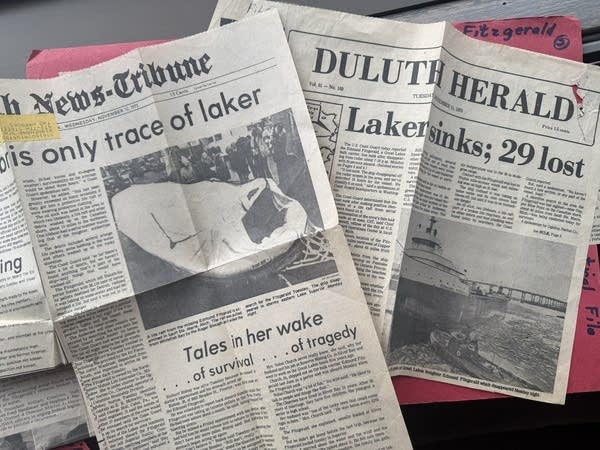
Just a few days earlier someone from Two Harbors had dropped off two folders full of yellowing newspaper clippings about the Fitzgerald. “Laker sinks. 29 Lost,” reads the headline from the Duluth Herald the day after it sank. “Oil, debris only trace of laker,” the Duluth News-Tribune proclaimed the following day.
That someone saved those clippings for 50 years is a “testament ... to how localized this is for us,” and to the power the Fitzgerald’s memory still holds for people who live in the region, Matuszak reflected.
That’s true for Reg Mortimer of Eden Prairie, who took pictures of the Fitzgerald exhibit to send to his mom, a teacher in Milwaukee who instilled in him an appreciation for the story of the wreck, and “the power of our inland, saltless seas.”
“Every November, she did a unit on the Edmund Fitzgerald and the Gordon Lightfoot song and how all that tied into Great Lakes history,” recalled Mortimer.
The ‘Pride of the American Side’
When the 729-foot Edmund Fitzgerald was built in 1958, it was the longest freighter on the Great Lakes. It was built to that specific length because that was the maximum size a ship could be and still squeeze through the Soo Locks, the bottleneck connecting Lake Superior with Lakes Michigan and Huron below.
The Fitz continually set records for speed and the size of the cargo she carried, as the sleek vessel completed her five-day journeys ferrying massive loads of taconite pellets from northern Minnesota to the steel mills along the lower Lakes.
When the Fitzgerald departed on Nov. 9, 1975, the weather was calm, but a storm was brewing. The National Weather Service issued gale warnings, forecasting 40 mile per hour winds. After midnight the warning was upgraded; 60 mile per hour winds were now forecast.

Edward McSorley, captain of the Edmund Fitzgerald, and Bernie Cooper of the Arthur Anderson, another iron ore freighter, decided to travel across the lake together, the Anderson following about 10 miles behind. They took the longer route along the Canadian shore for protection from the storm.
That choice meant that as they neared the east end, the ships would have to turn south to cross the lake to Whitefish Bay. With winds now barreling from the west, that gave the waves 350 miles of what’s called “fetch” to gain momentum, height and power as they hit the ships broadside.
“That’s the last way you want a wave to hit you, because now you’re rolling back and forth in danger of capsizing,” explained John U. Bacon, author of a new book on the Fitzgerald disaster called “The Gales of November.”
The longer journey also allowed an incoming storm from the southwest to reach Lake Superior, where it collided with a second storm barreling down from Canada.
Subsequent modeling of the weather conditions found that the Fitzgerald was lost “coincident in both time and location with the most severe simulated and observed conditions on Lake Superior during the storm.” The ship was in the absolute worst possible place at the exact wrong time.
"It was the granddaddy of the century,” said Dudley Paquette, captain of the Wilfred Sykes, another ship out on Lake Superior during the storm, in an interview with MPR News on the 25th anniversary of the sinking.
“When you’re looking at 70 knot winds steady and gusts over 100 (miles per hour). Thirty to 35 foot seas. That’s quite a wall of water. Terrifying.”

McSorley was also sailing blind. His radar malfunctioned; Cooper was helping him navigate. And when he turned south toward Whitefish Point, the lighthouse beacon was out.
When Cooper saw the Fitz had disappeared, he radioed the Coast Guard for help. In recordings of the radio communication, Cooper said, “I didn’t have him visually, I had him on the radar, he was exactly 10 miles ahead of us…”
“I asked him how he was making out with his problem. He said he lost those vents and he had a list,” Cooper continued. “He said he was holding his own. The last time I talked with him he said he was holding his own, and I lost contact after that.”
A railing had snapped on the Fitzgerald’s deck. Broken vents on the top of ballast tanks suggest the ship may have been taking on water. It was listing to one side.
And that was the last he or anyone else heard from the Fitz and its crew, says Frederick Stonehouse, a maritime historian who wrote the first of many books on the disaster, “The Wreck of the Edmund Fitzgerald.”
“They had been running through a patch of snow squalls that really was obscuring observation,” Stonehouse said. When the night cleared up about a half hour later, “there was no Fitzgerald.”
But it wasn’t just the storm that sank the ship, says Stonehouse. There had to be other factors that also contributed to the disaster, because the Anderson, only 10 miles behind the Fitzgerald, emerged relatively unscathed.
“Nobody else really got beat up by it, only the Fitzgerald. So now you’ve got to roll back and say, it really wasn’t the storm that sunk the ship. Something else happened," said Stonehouse.
There are several theories. The first government report blamed the sinking on hatch covers that weren’t properly sealed, allowing water to flood the cargo holds. That idea has been largely discredited.

Some believe the ship struck bottom in an area of shallow water near an island where the Fitzgerald passed. Others claim it must have been hit by a “rogue” wave, which toppled the freighter.
There’s a legend on Lake Superior of “the Three Sisters,” said Stonehouse, where one wave will merge with a second wave, which in turns melds with a third wave. “And you’ve got one humongous wave that then will strike a vessel and sink it.”
The ship also may have cracked apart at the surface. Author John Bacon explains that waves on the Great Lakes are much steeper than ocean waves, and twice as close together.
“You can have your bow in one 30-foot wave, and then 700 feet later, you can have your stern in another 30-foot wave, with nothing supporting it in the middle, except for 26,000 tons of taconite,” said Bacon. “That’s the same weight as 4,200 adult elephants. So with nothing supporting it, it can crack.”
The ship was also carrying more iron ore pellets than it was designed to transport. The Coast Guard had gradually loosened restrictions guiding how low Great Lakes vessels could ride in the water. When the Fitzgerald left port there was only about 11 feet between the surface of the lake and the deck of the ship, so the 30-35 foot high waves would’ve easily crashed over it.
Experts now say it was likely a confluence of factors that led to the Fitzgerald's demise, only about 17 miles — an hour of sailing — from the safe waters of Whitefish Bay. “Ships don’t sink from one thing,” said Stonehouse. “They usually sink from a whole chain of events.”
“I can point to a dozen factors, nature, of course, mechanical failures, the design of the ship, decisions made that night,” said Bacon. “And any one of them might be enough to save that ship if it went differently.”
“When you boil it all down, I go back to Ruth Hudson,” the mother of one of the 22-year old deckhands on the ship, Bacon added. “She said, ultimately, only 30 know. Twenty-nine men and God. And nobody’s talking.”
The Fitz’s Legacy
Fifty years later, the memories of those lost sailors are perhaps best honored by the many forecasting and safety improvements that have been made since then.
In the century prior to the sinking of the Edmund Fitzgerald, there were more than 6,000 shipwrecks on the Great Lakes, including two in the previous 20 years that killed more than 20 sailors each.
In the 50 years since, there hasn’t been a single one.
“Having a shipwreck of that magnitude was a real eye-opener for people,” said Jay Austin, a professor at the University of Minnesota Duluth's Large Lakes Observatory who has studied Lake Superior for the past 20 years.
When the Fitz went down there were no weather buoys on the Great Lakes. Now there are over 50, including over 30 on Lake Superior, several of them operated by UMD. They transmit data on waves, winds, temperatures and other conditions.
“So what the Weather Service is doing is looking at their models and looking at the real time data to try to understand where the shortcomings in these numerical models are,” Austin said.

Regulations were strengthened, safety training was enhanced, and ship design improved. For example, ships are now required to carry an emergency radio beacon that alerts search and rescue services in an emergency. The technology was available 50 years ago, said Stonehouse, but it wasn’t required.
“So you’ve had a sea change,” Stonehouse said.
Weather forecasting and communication has improved tremendously. Ship captains now receive detailed forecasts days ahead of major storms. And the real difference is what they do with those forecasts. Just look at a map of Lake Superior to see where the ships are whenever a major storm blows through, said Stonehouse.
“They ain’t in the middle of the lake. They’re anchored in somewhere, or they're tucked in, or they’re running the shore close.”
Common sense, said Bacon, has replaced hubris.
“Not one commercial shipwreck on the Great Lakes since that night, the families are very well aware of that. They’re very proud of it,” Bacon said. “They know as horrible as it was to lose their fathers and their cousins and uncles, because it got so much attention, the industry fixed itself.”
But that’s not to say it couldn't happen again, said Stonehouse. “The lake is like any sea, relentless. So I would hesitate to say never, but I would say that it becomes more and more unlikely every day as they ramp up the capability of the vessels and ramp up safety.”


 English (US) ·