
ARTICLE AD BOX
Critical DMs are lightly edited Slack conversations by members of the MPR News arts team about Minnesota art and culture.
This week, arts editor Max Sparber and senior arts reporter and critic Alex V. Cipolle discuss collections at the Minnesota State Fair.
Scrarecrows revisited
Max Sparber: Let’s begin by mentioning that last year, we explored the world of scarecrows at the Fair, and we peeked in again this year.
Alex V. Cipolle: Wonderful chaos, once again.
Sparber: Delightfully chaotic.
Cipolle: As I just started season 2 of “Wednesday,” I was happy to see the Wednesday scarecrow.
Sparber: It’s interesting seeing that just outside the crop art section, as crop art has definitely congealed into having preferred techniques and approaches.
And with this year has suddenly reached a sort of Renaissance, literally, with the crop artists reproducing classical art.
But scarecrows have no such group aesthetic.
Cipolle: It feels like crop art may be transitioning from outsider art to establishment art in Minnesota. The Scarecrows seem to be an antithesis. No discernible rules or techniques.
Sparber: I do see some motion, however — there were a few more explicitly political scarecrows. An Alligator Alcatraz one, a piece chastising actors for being in the new Harry Potter show.
When Minnesotans start scoring political points with farm art, the genre is growing up.
And I think this is what interests me in our newest exploration, Collections, in the Creative Activities building: It has no overarching idea of what it wants to be. It is not yet establishment.
Collections
Cipolle: Heck, it doesn’t even know where it wants to be.
It was pretty difficult to identify what was a collection or something else. I’m sure we missed many.
Sparber: Yeah, it’s scattered throughout the building.
Downside: Where is it? Upside: I got to look at pies, handmade clothing, art by senior citizens, and all the other stuff in the building, all of which could be its own story.
Cipolle: Yes, there were many happy accidents and discoveries along the way.
Sparber: But Collections is the least clearly defined of all of them. What is it? Whatever somebody collects and wants to show off.
There were Swatches, wooden earrings.
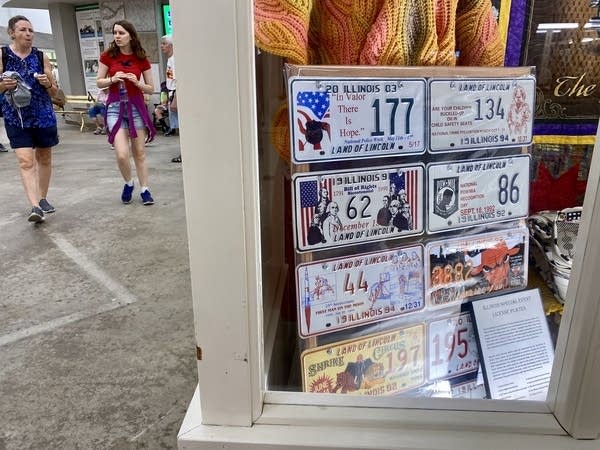
Cipolle: License plates — from a cop with some connection to Illinois.
Sparber: Those were unexpectedly interesting. They are specifically event license plates, all with their own designs. Parades, holidays, etc. I didn’t know they even existed.
I’d like to imagine there is one state employee whose only job is designing special license plates for whatever comes up. The mayor of Valley City has declared Giant Meteor Day — we need a license plate.
Cipolle: According to the collector, to qualify as a Special Event License Plate, the event "must be open to the public and promote the interests of Illinois citizens."
Mail-related collections
Sparber: The easiest collections to find are mail-related ones, although there are still some tucked into other exhibits elsewhere.
Stamp collecting, obviously, still has a big following.
Cipolle: Yes, there is a fantastic collection of Hmong and Laotian stamps from Donald Rudrud of Minneapolis.
Sparber: As long as there is mail, there will be Philately.
The Hmong and Laotian stamps were glorious. Some of the best colors I have ever seen on a stamp. Super-saturated pinks and purples
Some people, like this collector, collect stamps by theme. I wonder what I would collect?
I do have some stamps made from concrete to celebrate Switzerland's obsession with concrete. Maybe stamps made of surprising materials.
Cipolle: My favorite part of the collections exhibit is the postcards. This one I cannot stop thinking about.
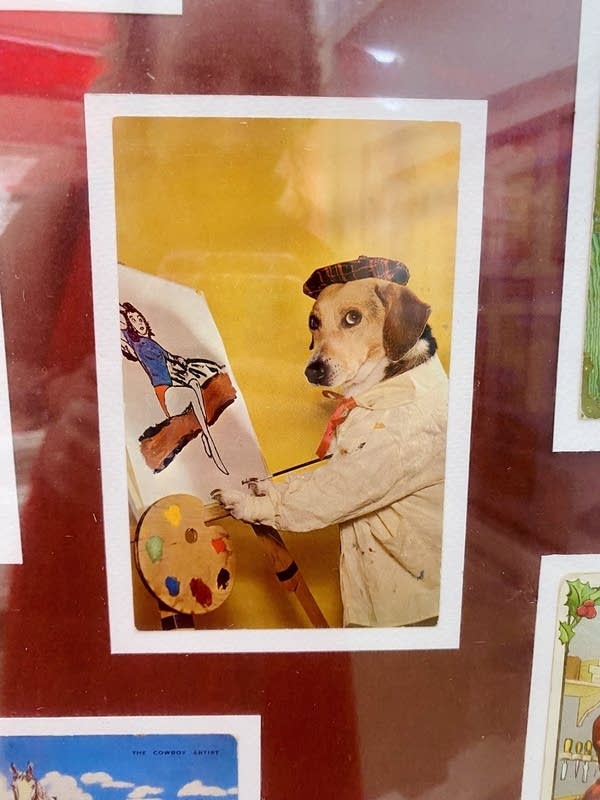
Sparber: We should make that the Art Hounds logo.
Cipolle: This collector has a collection of “Postcards featuring the Artist’s Palette.”
I just love how specific that is. And I love thinking about the photo shoot that produced this discerning doggo artist.
The collection also features bunnies and cats with palettes. And one that features a kid who says, “Let bad news walk on crutches.” I looked it up and it’s circa 1915.
Sparber: At the turn of the 20th century, animals did a lot more of the plastic arts.
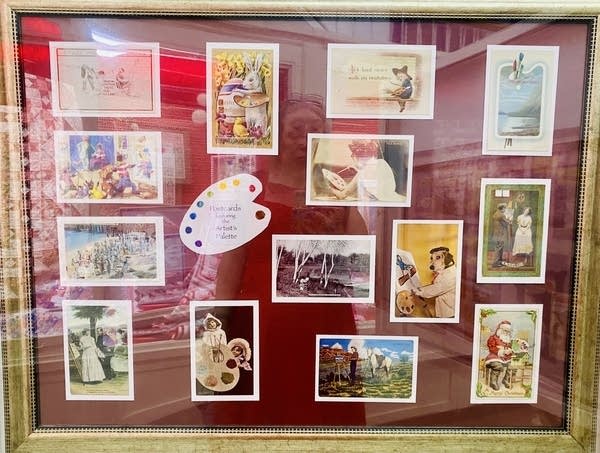
Cipolle: Then they stopped letting them into art schools. Whatta shame.
Sparber: The postcards were fantastic. I stumbled on one collection that was postcards of people showing off their postcard collection.
That’s like postcard postmodernism.
Cipolle: Postcards are a younger medium than I thought. Didn’t become mass-adopted until the early 20th century.
There was a time when it was illegal to have a message and an address on the same side of a piece of mail.
Sparber: Confused postal carriers trying to find an address that read HELLO JOHN FROM YOUR BROTHER.
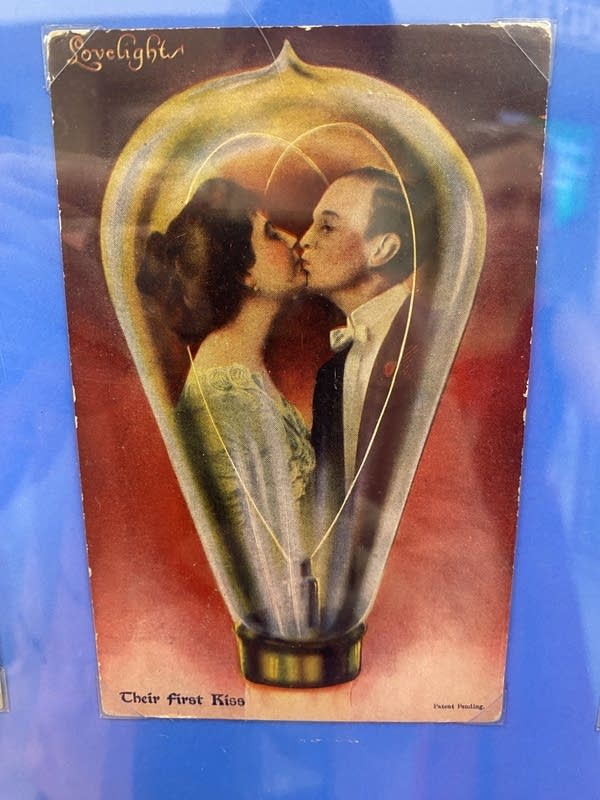
Cipolle: I also really loved the “lovelights” postcards, of couples ensconced in glowing light bulbs.
Sparber: Specifically, Edison lights, which makes me think they were advertisements.
“Get an Edison light bulb and you can squeeze your sweetie late into the night.”
Cipolle: There is one other postcard that has stuck with me: The woman sitting riverside with a squirrel, both unbothered by the encroaching hellfire.
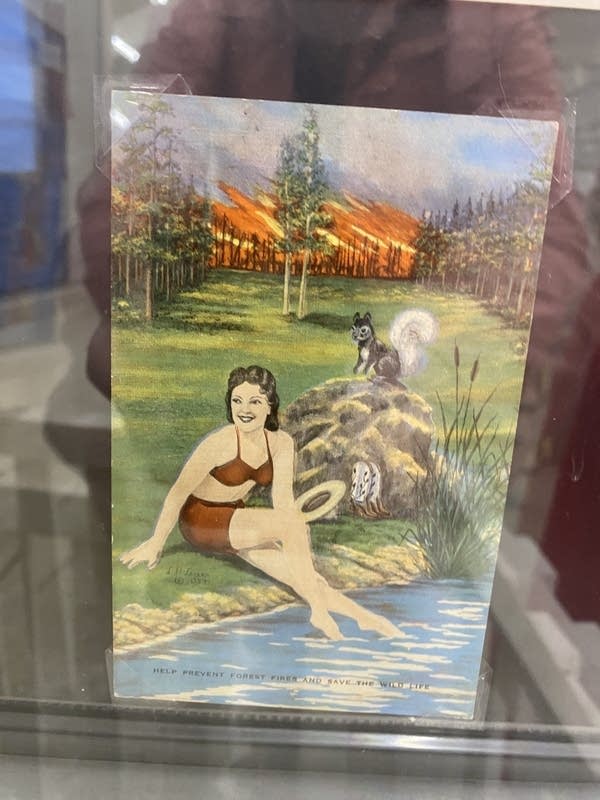
Apparently, it was printed in 1945 and feels like the postwar version of the “This is Fine” meme.
Sparber: The squirrel is also pretty mellow. Maybe it’s like that meme of the little girl grinning as a fire burns behind her.
They caused the fire.
Cipolle: Shortly after, we visited the Fine Arts Competition, and a giclee artwork by Beth Stahn of Sacred Heart, Minn., had the same feeling.
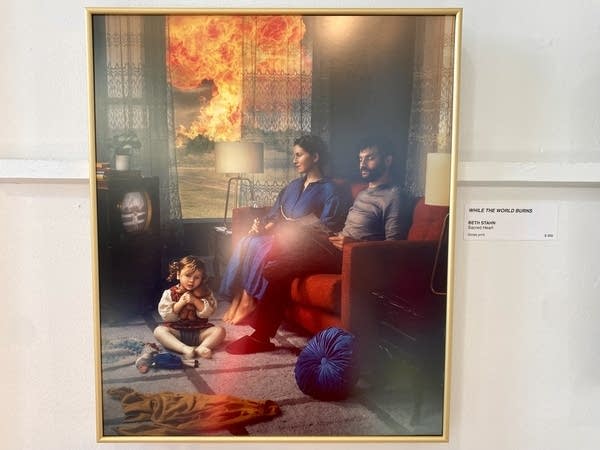
Sparber: The mood of the moment is: let it burn.
Cipolle: Which was hanging very close to Ross White’s painting, “This is Fine,” recently acquired by the Cafesjian Art Trust museum in Shoreview.
Unclaimed
Sparber: Let’s talk briefly about the saddest mail-related collection, and then we can discuss something more fun: pages from scrapbooks.
There is a collection of envelopes titled “Unclaimed: Return to Sender”
Cipolle: What a haunting collection. Beautiful that someone chose to collect it.
Sparber: At first, it looks like the collector was interested in the rubber stamp they used to mark the envelopes, an outline of a hand pointing to the return address. Which is a fascinating piece of 20th-century design.
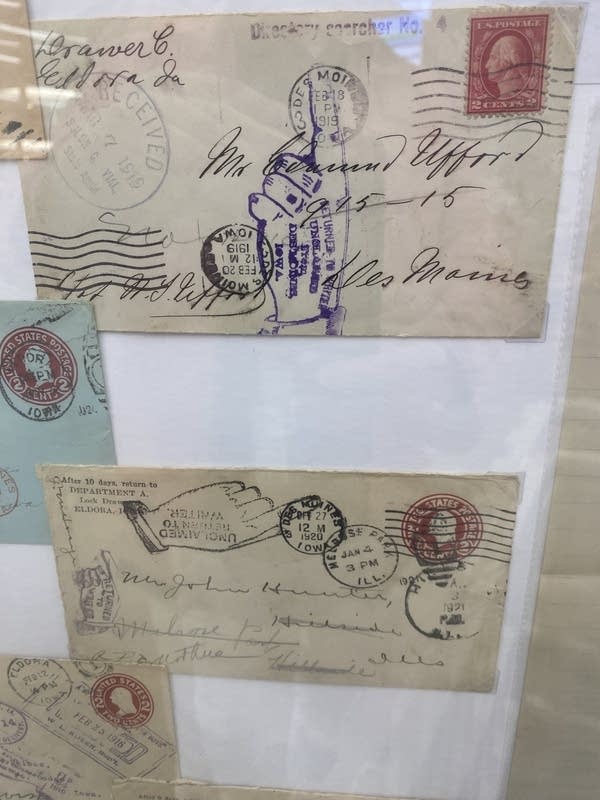
Cipolle: The hand is called a manicule. According to the collector.
Sparber: But no, these are all envelopes from boys sent to The Iowa State Training School for Boys, a sort of workhouse for juveniles.
Cipolle: And, now, break our hearts and explain.
Sparber: I spoke to the collector, Pete Boulay. He’s with the Maplewood Stamp Club, where somebody donated all these envelopes.
He had some horrifying stories to tell about the place, including an incident where a boy died and the rest ran off, and the Iowa National Guard got called in.
I read some more online, but it started to get very depressing.
So these are letters the boys wrote home, and they just never got there. Sometimes the parents had actually moved. One kid wrote asking for a suit and fare to come home.
Imagine getting these letters back.
Cipolle: It’s devastating. And I’m so glad Boulay recognized that this should be shared.
Sparber: Yeah, I feel like there were a few items in collections where I learned a lot about history. I learned about the Hastings Spiral Bridge across the Mississippi, which you got on through an enormous loop, and apparently, people in Hastings loved to have postcards of.
Cipolle: I wish we still had those bridges. I’m sure they’re not functional in today’s world, but they sure are lovely.
Scrapbooks
Sparber: I don’t know if I learned any history from scrapbook pages.
Cipolle: The scrapbooks …
Sparber: That’s the more personal, autobiographical side of Collections.
Cipolle: I can’t even with the scrapbooks.
Sparber: And, consistent with my tastes, far and away the most chaotic.
It’s huge business. A few years ago, the scrapbook industry was making billions of dollars per year.
Cipolle: They certainly feel the least deliberate of any competition I've seen at the fair.
Sparber: It was just ... whatever.
A young woman kissing the first fish she caught. Grandma’s birthday.
Cipolle: A random vacation, people eating Italian food, a little boy and his many hats (OK, that one was amazing).
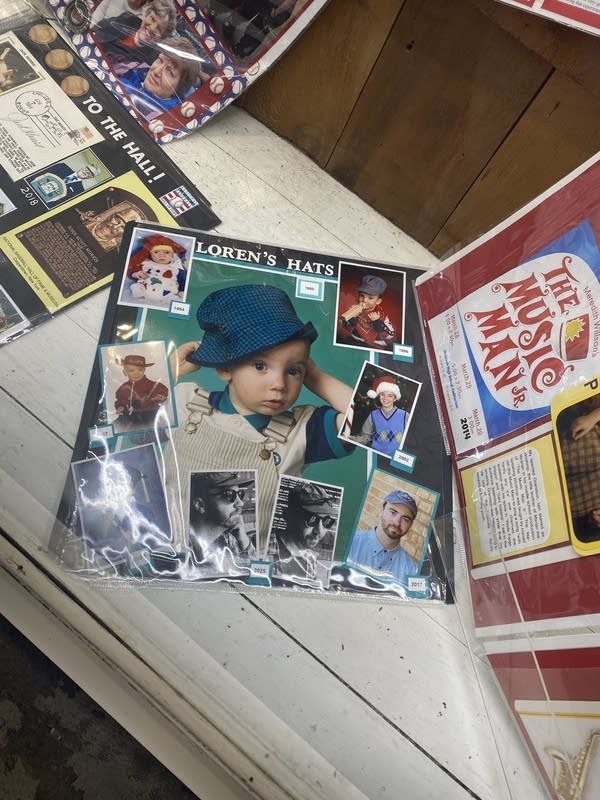
Sparber: That’s my favorite, LOREN’S HATS: Loren wearing hats, from childhood to young adulthood. Santa hats, cowboy hats, engineer hats.
Loren loves his hats.
Cipolle: And the world needs Loren and his many hats.
Sparber: Loren is the Bartholomew Cubbins we didn't know we needed.
Cipolle: I also liked Craig Barrett’s life as a postal worker scrapbook, from 2002 to today.
Sparber: Somehow, it always comes back to mail.
I can’t even complain; American history is bound up in our postal system. You could do a mail art exhibit, and it would fill seven museums.
Cipolle: The scrapbook collection is celebrating 250 years of the U.S. Postal Service. One important date in postal history that Barrett teaches us:
1973 was the year that carriers were authorized to wear shorts.
Sparber: Before that, they needed long pants to protect them from the various dogs sitting on the lawn doing fine art.
Cipolle: Only the state fair could produce a line like that
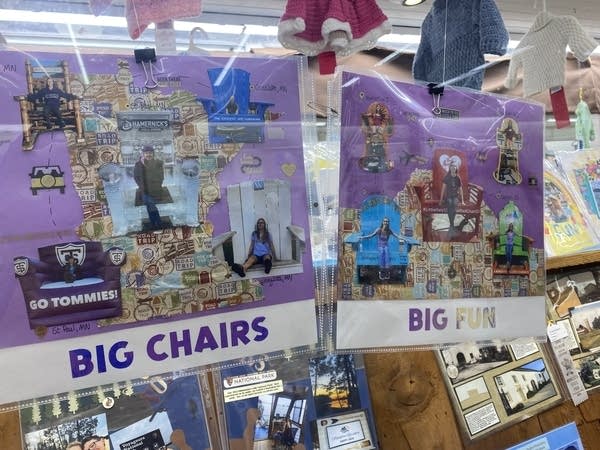
Sparber: I also loved two scrapbook pages called BIG CHAIRS BIG FUN.
Just someone sitting on comically oversized chairs. I also like to sit in comically oversized chairs. And I wear hats.
Scrapbooking is me.
Cipolle: You are a walking scrapbook, my friend. Next year, just sit in the glass case, and you'll win a blue ribbon.
Sparber: Let me grab some postcards and kiss a fish.


 English (US) ·