
ARTICLE AD BOX
By Becky Z. Dernbach, Sahan Journal
This story comes to you from Sahan Journal through a partnership with MPR News.
A group of Hmong parents in St. Paul Public Schools is urging families to keep their children home Dec. 15, in anticipation of a school board vote the following day on next steps for the district’s Hmong language and culture school.
Sai Thao, one of the parents organizing the action, said so far parents representing about 500 kids have pledged to keep their children home. Ultimately, she expects more than 2,000 children to stay home.
The stay-at-home day is the result of frustration with the district’s approach to managing its popular Hmong language and culture programs — and delay in providing a large enough school to accommodate all the students under one roof.
“We’ve been made invisible,” Thao said. “So staying home and being invisible hopefully brings that visibility to light.”
With nearly 700 students, Txuj Ci HMong Language and Culture School has the highest enrollment of any elementary school in St. Paul Public Schools. The district has touted the school’s growth as a success story, noting that the popularity of language and culture programs has helped stabilize overall enrollment. In 2022, the district opened a separate Txuj Ci middle school.
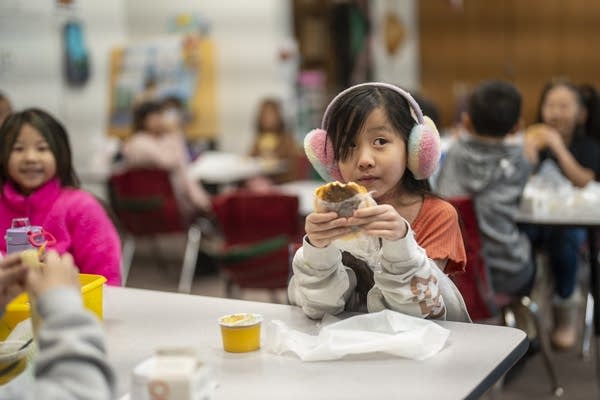
But as enrollment has grown, the elementary school has struggled to find space for its students. Due to limited cafeteria space, some students don’t eat lunch until 2 p.m. Prekindergarten and fifth grade have in different years been shifted into other buildings.
The school board voted in July to create a preK-8 school for Txuj Ci, a longtime community wish that would bring the two schools under one roof. The district anticipates that school would open between 2031 and 2033.
But parents, who have been working on the problem for years, say they need to solve the overcrowding problem sooner, and that inaction will harm the program. Frustrations boiled over this fall when Superintendent Stacie Stanley said she could not recommend either of two proposed interim solutions, including one brought by parents.
“Why would you not want to support a program that is bringing enrollment into your school district?” asked Shela Her, a Txuj Ci parent.
Several parents told Sahan Journal that the school board’s decision on Dec. 16 would determine whether they keep their children in the district.
“They really want numbers,” said Ying Yang, one of the organizers of the stay-at-home day, “but they don’t want our voices.”
Rotating solutions to a growing need
St. Paul Public Schools began its first Hmong language program at Jackson Elementary School in 2006. Txuj Ci, then called Phalen Lake Elementary School, followed in 2011. Parents say the program helps children communicate with older relatives, and creates a sense of cultural pride and identity. Two different tracks are available: Hmong dual language, which focuses on language immersion, and Hmong studies, which focuses on culture.
Before the pandemic, parents already concerned about crowding approached the district for a larger building for pre-K through 8th grade. The space limitations at Txuj Ci became even clearer in 2022 after Jackson Elementary closed and merged its Hmong language and culture program with Txuj Ci. In 2023, to address the crunch, the district moved Txuj Ci prekindergarteners to a different building.
But parents objected to separating their youngest students from their older siblings. Children were split between three buildings, and the littlest kids were on their own.
“I think that’s what the parents got frustrated at because they wanted the older sibling to watch out for the younger one,” said Pao Vang, also a Txuj Ci parent. “With Hmong, we want all our kids to stick together, stay together as much as possible.”
The shift also meant more buses and start times for parents to navigate. When Bao Yang’s youngest child started prekindergarten in the separate building, all four of her children were in different schools, which she said was “really difficult to manage.”
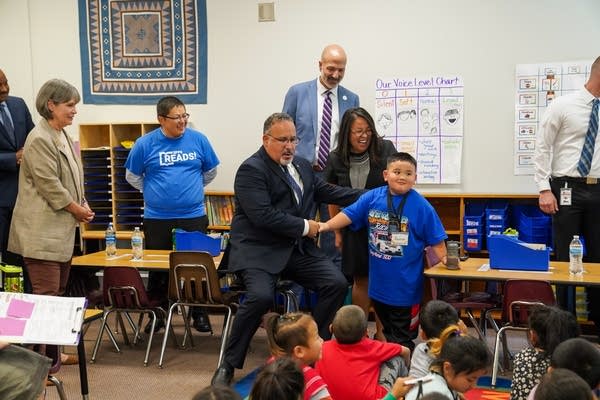
In December 2023, the district convened a facilities committee to decide on next steps. Parents recalled the district told them they would have a preK-8 building in three to five years. The work group voted to bring back the prekindergarteners and move the fifth grade to the Txuj Ci middle school starting in 2024 until the preK-8 school was ready.
But the district later said the timeline for the preK-8 school would be closer to 10 years, which hit parents hard.
“The work group was just devastated,” Thao said. (Thao is married to school board member Jim Vue, but stressed she was speaking from her own experience as a parent.) “With the 10-year timeline, we have a school that is still growing, enrollment in demand, but really no room to accept enrollment.”
At a Dec. 2 school board meeting, St. Paul Public Schools facilities director Kathy Wallace said she did not recall specifying a five-year timeline in detail, but that it was “a general statement that it was going to be a while.”
Parents on the committee did not want to keep fifth grade at the middle school for 10 years. Her, whose child was in fifth grade at the middle school last year, said that the fifth grade was isolated from the middle school in its own wing of the building, and only had physical education and science specialists. “Definitely not getting a well-rounded education,” she said.
So the committee looked for another interim solution, and voted to recommend moving the smaller Hmong studies program into a separate building from Hmong dual language. That way, they reasoned, both programs would have room to grow until they could come back together.
Thao said the group chose the “least disruptive” option from the choices the district presented.
“If we don’t separate Hmong studies and move down our fifth graders, we can’t grow our enrollment,” Thao said. “So what that means is that when we get to the next stage, we may not have the enrollment in order to get into the building that we need.”
On March 12, the majority voted to recommend moving the Hmong studies program into the building that had previously housed the prekindergarteners.
‘I cannot recommend either option’
But the committee’s recommendation did not reach district leadership for another six months. Stanley began her job as superintendent in May, and was not briefed on the Txuj Ci facilities planning until Vue called her in September.
In an Oct. 7 school board meeting, Jackie Turner, the district’s chief of administration and operation, briefed the board on two options: moving the Hmong studies elementary program to the empty building on Prosperity Avenue that had housed the prekindergarteners, as the work group recommended, or relocating it to another East Side school, Hazel Park Preparatory Academy.
Turner said that the Prosperity building would not allow the Hmong studies program to expand beyond its current size. Both options could result in splitting up some families, she said. She also questioned whether the work group’s recommended solution would result in unequal opportunities for students in the Hmong studies program. Elementary schools with more students have access to more specialists like art and music classes.
Stanley said that in the big picture, with the district asking voters to approve a $37 million funding referendum and projected major enrollment losses, she couldn’t recommend either option.
Vue pushed back, pointing out the delay in considering the recommendation, shifting criteria for making a decision, and the fact that the work group had never considered co-locating at Hazel Park. “If this is how Saint Paul Public Schools works with community, then it’s tough for me to say that we actually work with community,” he said.
School board member Yusef Carrillo said he shared Stanley’s feeling that the two options before them were “not really good options.” Still, he said, accommodating Txuj Ci’s needs was critical to sustaining the district’s enrollment.
He suggested a “sprint” of community engagement through October before the board made a final decision in December. The board agreed to a series of engagement sessions with both the Txuj Ci and Hazel Park communities.
Stanley expressed empathy for the Hmong community.
“From my heart, I understand that there is a sense of not being valued and not being listened to for many years,” she said. “And as a superintendent right now, I really do have to take a whole-systems view.”
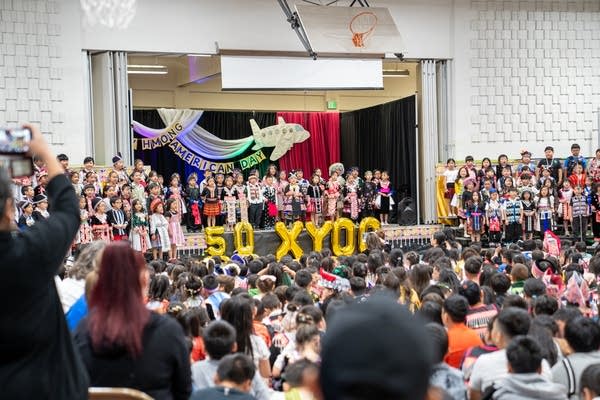
‘Disrespectful and dismissive’
But in the Txuj Ci community, Stanley’s unwillingness to back either option didn’t go down well.
“It was very, very disrespectful and dismissive to have only learned about our work on September 11, and then three weeks later to dismiss it,” Thao said.
“It wasn’t just saying no to our school community. It was saying ‘no, Hmong people, you are not important, and I don’t need to make a decision,’” Her said.
Ying Yang has two children at Txuj Ci Lower. For him, the space needs are acute. His fourth-grader is one of those who eats lunch at 2 p.m. because of the overcrowding. That same child, who has an individualized education plan, sometimes needs to go into a separate “buddy room” with an adult to reset. But there is no separate room available for her at Txuj Ci.
He questioned whether Stanley had done her homework.
“I get that she was new this year, but that just means that she has to work twice as hard to catch up, and I don’t think she did that,” he said.
He said he and his wife had discussed leaving the district.
“It’s almost like a carousel,” he said. “You ride a horse, you go around, and then you get off. And then the next time they want you to get on the same horse and you ride again. So I’m not sure how much longer we can do this.”
No clarity from engagement sessions
The engagement sessions suggested by Carrillo did not result in a clear path forward.
“I feel less clear about what the community as a whole wants, and I feel less clear about what we actually offer to the community in good faith,” Carrillo said in the Nov. 5 school board meeting. “I think when it comes down to it, we inherited a lot of harm done.”
Parent Shela Her said the muddled results came from the district’s “one-sided” presentation, which she said pitted one part of the school community against another.
A feeling had developed among Hmong studies parents that Hmong dual language parents were trying to push them out, but the committee was trying to save both programs, she said. This year, Txuj Ci has only one kindergarten Hmong studies section, down from two in previous years.
“Right now what’s happening is they are actually decreasing the number of Hmong studies classrooms to be able to make room for the Hmong immersion classrooms,” Her said. “We don’t want it to slowly diminish over time by the time we get the preK-8 school.”
Erica Wacker, the district’s communications director, said that classroom section allocations are based on student enrollment and applications to the Hmong studies or Hmong dual language programs, as well as class-size caps.
At a breaking point
Pao Vang, who has children in both the Hmong studies and Hmong dual language programs, was “shocked” when he heard the programs might be separated. He walked out of the Oct. 7 meeting in disbelief.
Vang’s older son is part of the Hmong dual language program, while his younger son is on the Hmong studies track. He recalled the facilities committee discussing separating the programs two years ago and rejecting the idea.
“It was not voted on. It was not even very popular back then, and the parents didn’t like it at all. And yet here it is two and a half years later, after everything else, now they’re going back to that process,” he said.
He understood the committee’s argument that in the long term, separating the programs was in the school’s best interest. But he still did not want to split them up — or move his child to a new school with a new principal and new teachers. And he questioned whether other Hmong studies parents knew about the possible move.
He would rather keep fifth grade in the middle school and keep the two programs together, he said. His fifth-grade son is at the upper campus, he said, and while he misses the lower school, he enjoys having his own locker and playing sports with older kids at recess.
Jann Her, who also has a fifth-grader at the middle school and younger kids in the Hmong studies program, said she’d prefer to keep the current arrangement. But it would be okay with her if Hmong studies moves to another school, she said.
“Because it’s still the Hmong studies, and as long as there’s some sort of integration of the Hmong culture, personally I’m okay with that,” she said.
But Vang said he was reaching a breaking point. If the district decides to separate Hmong studies from Hmong dual language, he said, “I will have the decision of taking them out and putting them in a different school.”
He plans to keep his kids home on Dec. 15.
“I feel like the school district has not really done much to help us as a school. It’s always a solution of move this out, bring this back, doing puzzle pieces,” he said.
Bao Yang said she, too, was considering moving her kids to a charter school, like her nieces and nephews attend.
“It just seems like they don’t have to go through this,” she said. “They already have a building, and they were able to get an extension on the building, meaning they were able to expand it. And it just seems like maybe it’s not worth being in St. Paul Public Schools.”
If the district does not move Hmong studies to the Prosperity Avenue location, she said, she would move her kids to a charter school.
The school board plans to vote Dec. 16 on whether to move the Hmong studies program and to which building. Families are planning a rally outside the school district headquarters that evening.
Use the audio player above to listen to a conversation with Minnesota Now host Nina Moini and the reporter of this story, Becky Dernbach.


 English (US) ·