
ARTICLE AD BOX
Wednesday was Lucia Webb’s second day doing ICE watch in Minneapolis. It was just two days after the federal government launched its expanded immigration enforcement actions in the Twin Cities.
In her car, she followed federal immigration agents from south Minneapolis to a park-and-ride lot by the Minneapolis VA Medical Center’s light rail stop. That’s when her car was boxed in by four ICE vehicles and surrounded by mostly masked federal agents.
One agent told her she can’t be “chasing” them around the city. She replied that she wasn’t chasing. The agent said she was breaking the law by following them, and that he would arrest her if she didn’t stop “impeding.” Minnesota law requires vehicles to travel 500 feet behind emergency vehicles when they’re responding to an emergency, although Webb said the ICE vehicles hadn’t activated emergency lights.
The agent told her, “You can not do this.”
Webb insisted, “Yes, I can. Yes, I can.”
The 31-year-old south Minneapolis resident who works for a nonprofit, is just one of hundreds, and likely thousands, of Twin Cities residents volunteering to make ICE’s job in Minnesota as difficult as possible.
The goal of these ICE watchers, as Webb told the agents, is to protect their neighbors.
She asked the agents if they were embarrassed to be kidnapping people like “Nazis.” They replied “Not really,” crudely insulted her appearance and got back in their vehicles. She stayed in her parked car and cried.
“I just felt so sad and really shaken,” Webb said a day after the confrontation. “You’re like, ‘They can't do anything to me,’ and it feels like they can when you're in that moment — yeah, I felt scared.”
For solace, Webb turned to chats on the phone messaging app Signal, which has become an integral tool in activism against ICE across the country. Before the immigration crackdown, she said her neighborhood chat was mostly talk about lost cats or invites to backyard barbecues.
The chats, and the anti-ICE efforts in the city, are decentralized, based on blocks or neighborhoods or even apartment buildings. Many of these neighborhood chats were birthed during the unrest following George Floyd’s killing by a Minneapolis police officer in 2020, when police had largely disappeared from many parts of the city, and neighbors organized safety patrols.
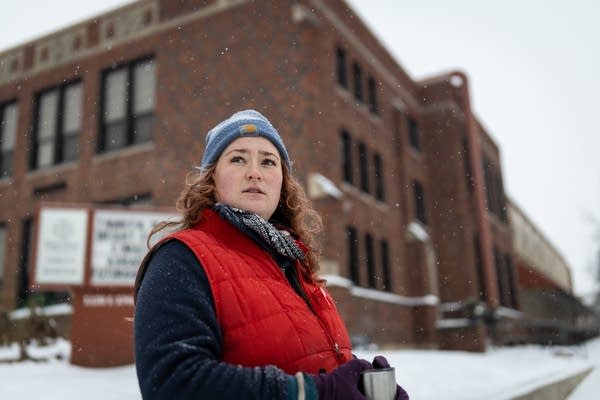
Webb told people on the chats she was frustrated by her emotional reaction to what she saw as intimidation by the federal agents. She said others on the chat responded kindly, even offering hangout invites for tea and candy.
Her stop by ICE didn’t deter her from volunteering for even a day. She plans to go out in her car again, and has been standing watch at a local Catholic school with a heavy Latino population during drop off and pickup times.
“It just reminds me that people can and will show up, and that there's a lot of us. There’s more of us than there are of them,” Webb said. “I have a meeting later this afternoon, so I'm not going to be out driving on the streets, but other people will be — that feels powerful.”
‘The opposite of safety’
While the state of Minnesota has already seen an uptick in federal immigration detentions, the state had avoided until this week becoming a hotspot for immigration enforcement like places like Chicago and Los Angeles.
That changed after President Donald Trump’s comments calling Somali-Americans “garbage,” and reportedly vowing to send 100 agents to apprehend Somali-Americans who have deportation orders, despite the fact that the majority of Somali-Americans in Minnesota are American citizens. Minnesota is home to the largest Somali population in the United States, with an estimated 80,000 Minnesota Somalis.
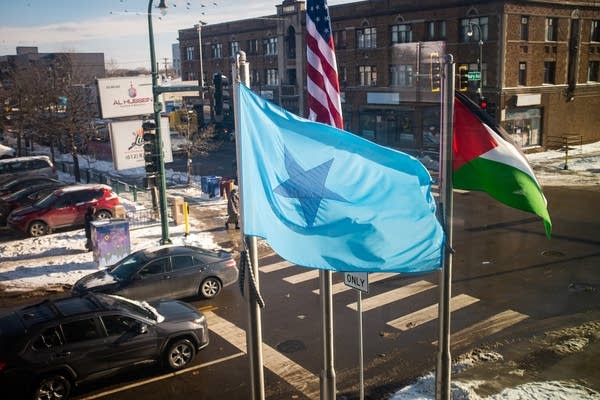
An ICE spokesperson has confirmed that ‘Operation Metro Surge’ in the Twin Cities began Monday, Dec. 1. They’ve identified 12 men arrested so far during the action, including five originally from Somalia.
But it’s not clear how many other people may have been detained — or how long the federal crackdown is set to last. Arrest data shows that most immigrants swept up by ICE in other cities had no criminal record.
Trump’s statements this week, which critics described as “racist” and “vile,” supercharged efforts by Twin Cities advocates for immigrants. There are now decentralized Signal chats like the one that Webb was using to find the ICE agents in many parts of the Twin Cities. One Minneapolis Signal chat has over 500 members.
Users on the chats coordinate with one another to vet reports sent into a tipline, gather protesters at the scenes of arrests and organize actions like a late-night noise demonstration on Thursday at a hotel where ICE employees are reportedly staying.
Dan, who asked to be identified by his first name due to concerns about retaliation from ICE, helped launch an effort in northeast Minneapolis. He was spurred to create a rapid response in his neighborhood after a man working at his neighbor’s home was arrested in July.
People find the chat through word of mouth, often after a high-profile ICE action. They urge all volunteers to get trained and learn how to remain calm during confrontations with agents.
“We’re building out for sure, and we're trying to model best practices from other cities that have seen similar levels of intensity,” Dan said. “If one thing is clear, Minneapolis in particular will come together, and we will fight for justice as a whole city.”
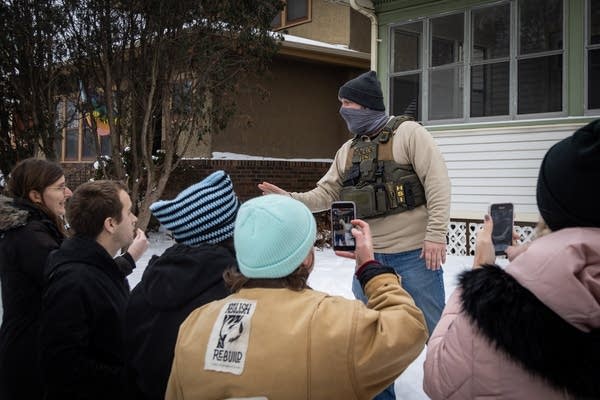
He said volunteers across the city are taking on all sorts of roles in their attempts to keep immigrants out of ICE’s hands. Some patrol for ICE agents and report their locations to people in a chat thread.
Others observe officers and record their actions or alert neighborhoods with whistles when ICE is nearby. Then there are people who chip in however they can, bringing hot coffee to volunteers or standing watch outside a day care.
Activists say the ultimate goal is to prevent ICE agents from arresting, jailing and deporting their neighbors. That can be challenging, Dan said, because there seem to be few repercussions for ICE agents who break the law.
Dan said the federal presence in Minnesota has meant “the opposite of safety.”
“They’re pointing long guns in people’s faces. They are driving erratically. They are harming us and our safety and our way of life,” Dan said. “The only way to take that on is to have as many people as possible in a community.”
There isn’t one organization running these activities. It’s decentralized by neighborhood and doesn’t have any formal leaders. Many of the volunteers, Dan said, aren’t in immediate personal danger from ICE, but feel like they can put their bodies on the line for their neighbors.
“What we’re seeing in this country is some of the most awful, if not the most awful, blatant racism and pain and brutality, and it has to just be taken on, head on,” Dan said. “And, yes, as a white man, I have unique privilege and ability to act, and I know I have to take that on.”
‘I will blow my whistle’
On the south side of town, Jonathan, who also asked to be identified only by his first name to avoid retaliation from federal authorities, said he’s been skipping work to patrol for ICE agents. He feels especially connected to Somali immigrants, some of whom helped care for him when he was a troubled teenager in the city’s Cedar-Riverside neighborhood.
Jonathan said he wants to protect his neighborhood, full of immigrants and other working-class people, from what he sees as a violent invasion by outsiders.
“I’m just one person who's just driving around, and if I find feds, I will honk at them, and I will blow my whistle, and I will scream,” Jonathan said. “I will do what I can do. And that's kind of it.”
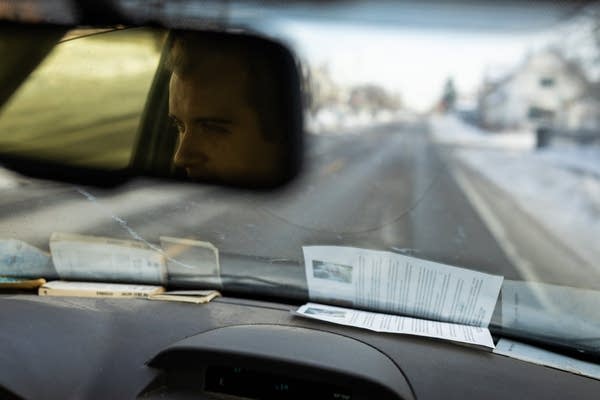
As a volunteer, Jonathan has spent a lot of time checking out tips that didn’t pan out — maybe a tipster was just being paranoid about a sketchy SUV or maybe ICE agents were gone by the time volunteers arrived. Mostly Jonathan drives, checks his chats for updates and watches for the telltale signs: “Tinted windows and out-of-state plates.”
Jonathan said he’s a calm person with a defiant streak. He enjoyed tracking ICE agents to a restaurant on Chicago Avenue on Thursday afternoon, running them off from their lunch break. He’d rather spend a night in jail than see a neighbor locked up for months or deported.
While he appreciates efforts by Minneapolis, including the mayor’s executive order banning ICE from using city-owned parking lots to stage actions, he doesn’t have faith that police or anyone at City Hall will be coming to the city’s rescue.
“We’re seeing that local government can’t protect us from the national government, and that kind of doesn’t leave you with very many options other than sort of, like banding up with people in your community,” Jonathan said. “I think the reality is we’re kind of out here on our own.”
The Minneapolis streets are pretty quiet on Thursday afternoon. Jonathan drives past a post office and a park where ICE has been seen in the past. Nothing. Then he gets a message about an ICE presence on Park Avenue just south of Lake Street. He swings his car in that direction and peers down the block.
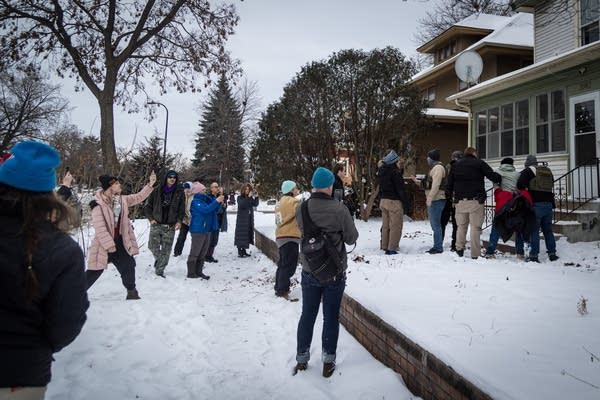
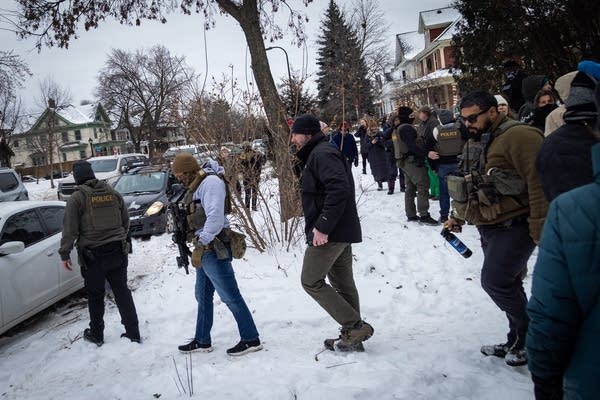
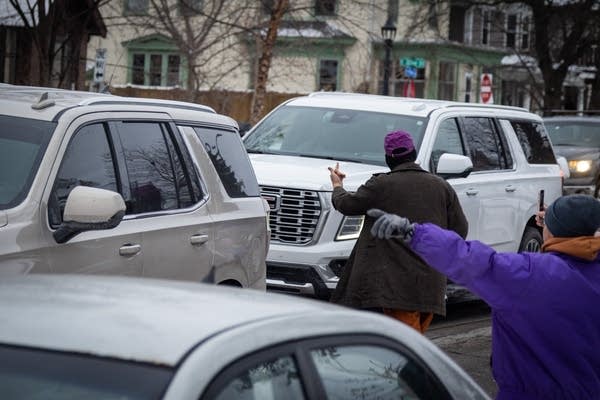
Some SUVs are blocking a lane of traffic. And federal agents in masks and ballistic vests are on the snowy front lawn of a home. They have an East African man handcuffed as a handful of ICE watchers blow whistles and shout from the sidewalk.
One agent tells the ICE watchers they’re just looking for the man’s residency number, but he’s locked out of his apartment. They drop him in the snow. It’s well below freezing. People on the sidewalk demand to see the officer’s warrant. The federal agents ignore them.
The Signal chats in this part of the city light up. More people keep arriving, and doors to neighboring homes keep opening, until about 30 supporters and neighbors are on site.

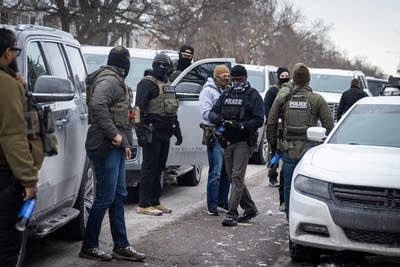
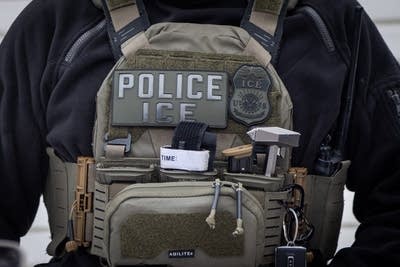
More agents also arrive, shaking cans of pepper spray and wielding rifles. They line up in the snowy yard in front of the angry, growing crowd, which briefly chants “Leave our neighbors alone,” before returning to blowing whistles and hurling profanity at the mostly masked agents.
Federal agents at the scene did not respond to questions or identify which agencies they work for. ICE’s spokespeople did not reply to multiple requests for comment about their actions at the home.
Then, after less than ten minutes, the agents troop out to their SUVs and drive off without making an arrest. As the volunteers celebrate, some jump in their cars to follow. Others cluster on the sidewalk, helping to sign new neighbors up on their local Signal chat.
Not long after, as the sun was going down, an SUV with tinted windows and an out-of-state license plate was seen barreling down a nearby street. It was followed closely by three cars, with drivers laying on their horns and whistling.


 English (US) ·