
ARTICLE AD BOX
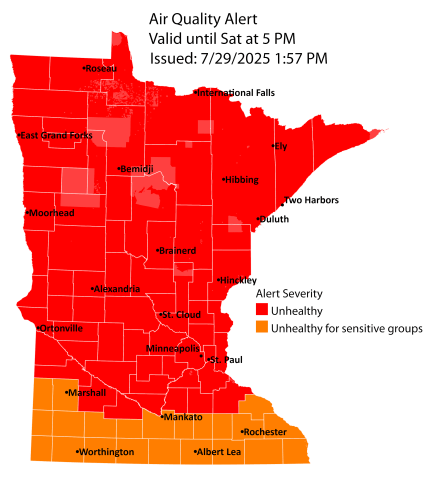
An air quality alert has been issued for all of Minnesota through Saturday as smoke from wildfires in Canada continues to drift south.
Here’s what to know when an air quality alert is issued and how to stay healthy amid smoky skies and unhealthy air.
What do air quality readings mean?
The Minnesota Pollution Control Agency issues air quality alerts for the state. The air quality index, or AQI, categories are:
Green — good
Yellow — moderate
Orange — unhealthy for sensitive groups
Red — unhealthy for everyone
Purple — very unhealthy for everyone
Maroon — hazardous
You can find current air quality conditions and forecasts on the MPCA’s website.
For the alert issued through Saturday, the MPCA says air quality is expected to reach the red AQI category in northern and central Minnesota, and the orange AQI category in southern Minnesota.
Who is most at risk when air quality is unhealthy?
Certain groups face heightened danger when air quality drops. The MPCA says the following populations are most at risk of health problems related to air pollution:
People with lung diseases, such as asthma, chronic bronchitis, emphysema, and chronic obstructive pulmonary disease
Infants and young children
People who work or exercise outdoors
Adults over 65
People with a cardiovascular disease
People in poverty; people who lack access to health care
People who smoke or are exposed to second-hand smoke
People working in occupations where there is high exposure to contaminated air
People who spend a lot of time near busy roadways
How to protect yourself
The best way to protect yourself from unhealthy air is to stay indoors as much as possible and limit the time you spend outside. If you do spend time outside, avoid exercising or other strenuous activities.
This guidance goes for all people, said Dr. Zeke McKinney, an occupational and environmental medicine specialist at HealthPartners, in an interview with MPR News in 2023.
While those with pre-existing medical conditions (asthma, COPD, heart disease), people who are pregnant, older people, children and people who work outside are most at risk for becoming sick, “this is something that we should all take seriously,” McKinney said.

He also recommends people consider wearing a face mask to protect their lungs from smoke and dust. The best options are N95 or KN95 masks, which are also called respirators because they fit very close to the face. A particulate respirator such as a P100 from a hardware store is also a good choice to protect against wildfire smoke and ash, according to the U.S. Environmental Protection Agency. Other types of masks and face coverings do not offer as much protection. You can also make your own air filter for wildfire smoke.
How does poor air quality from smoke affect people?
Potential symptoms from wildfire exposure include coughing, trouble breathing, wheezing, asthma attacks, stinging eyes, scratchy throat, runny nose, irritated sinuses, headaches, tiredness, chest pain and fast heartbeat, according to the Centers for Disease Control and Prevention.
The Environmental Protection Agency says exposure to smoke can also cause illnesses like bronchitis or aggravate existing chronic heart and lung diseases. The fine, microscopic particles in smoke can enter your eyes or respiratory system whether someone is inside or outside.
How can I protect my home from unhealthy air?
Keeping doors and windows closed will minimize the amount of outside air coming into your home. If you have central air conditioning, set it to recirculate air, if possible.
McKinney also recommended that people make sure their furnace and air conditioner filters are clean. If you have central air conditioning, you can install a high-efficiency filter (MERV 13 or higher) to increase air filtration, advises the EPA.
Air purifiers can reduce indoor air pollution, but cannot remove all pollutants from the air, according to the EPA.

If buying an air purifier isn’t an option, consider making a Corsi-Rosenthal box, which is a do-it-yourself air purifier made of a box fan and a few air filters.
Avoid doing things that make indoor air quality worse — burning candles or incense, vacuuming, smoking and using stoves, ovens and fireplaces can increase pollution.
How do I improve the air quality in my car?
Using the recirculation button will reduce the amount of new, polluted air entering your vehicle, as well as closing windows and vents, according to the Minnesota Pollution Control Agency.
The MPCA also recommends taking routes that are less congested if there are air quality concerns. Most cars have cabin air filters intended to protect passengers from harmful air. These should be replaced every 15,000 miles or so.


 English (US) ·