
ARTICLE AD BOX
By Shubhanjana Das and Katrina Pross |
Sahan Journal
This story comes to you from Sahan Journal through a partnership with MPR News.
“Where did you sleep last night?”
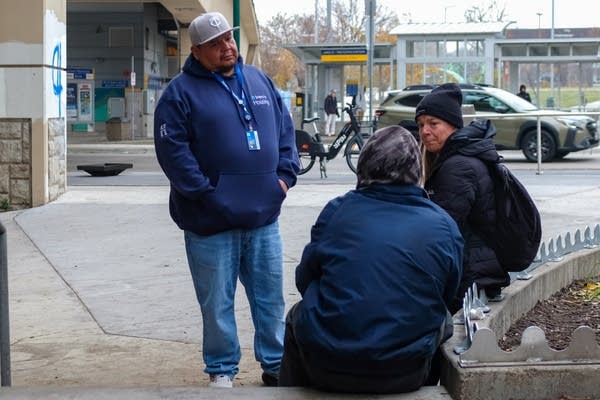
Lisa Gustner asks the question as she talks with people on E. Lake Street in south Minneapolis on a gray November day.
She and her colleague Mervel LaRose approach people they suspect might be struggling with homelessness. Others on the street call out to them after seeing their clothing emblazoned with the name of Hennepin County’s Streets to Housing Program, for which Gustner and LaRose do outreach as part of the county’s response to homelessness.
Asking where someone slept the night before helps Gustner gauge how severe their situation is and if they may qualify for county services.
“Some people don’t sleep, so they stay up all night,” she said.
That’s why it’s common to see people experiencing homelessness sleeping in public areas during the day, she said.
Gustner and LaRose walk up to a man sitting on concrete steps near the Lake Street Midtown Transit Station. They learn that he doesn’t have a place to stay. LaRose calls around to nonprofits that serve Native men facing homelessness to see if he can find a bed. While they wait to hear back, they instruct the man on what to do next and where he can find help.
“Be safe,” they tell him as they resume walking down Lake Street.
The county is targeting chronic homelessness, a federal definition from the U.S. Department of Housing and Urban Development (HUD) that describes people who have been homeless for more than one year or on at least four separate occasions in the last three years, and have a disability.
In 2023, Hennepin County created a goal to end chronic homelessness by the end of 2025, partnering with a national organization to collect better data on the issue.
As the year draws to a close, that goal is far from completion, although the county has made strides. While it has been able to house more than 700 chronically homeless people since October 2023, 254 people were experiencing chronic homelessness in Hennepin County in November.
“We’re still in it, but it is not likely in the next month that we are going to achieve the end-of-2025 goal,” said Danielle Werder, senior department administrator with Hennepin County’s Office of Housing Stability.
County officials say difficulties in data collection and an end to pandemic-era funding are factors that kept that goal from coming to fruition. Now, with substantial reductions in federal funding for housing services, the number of unhoused people is once again on the rise, and challenges are piling up.
They said they are still committed to ending chronic homelessness, but are not setting a new timeline.
“Where we are at is we are still laser-focused on ending chronic homelessness,” Werder said. “We’re still going to create bold goals, but we also don’t want to create false starts by declaring something that may not be completely in our control to get to.”
Difficulties with data
A major aspect of Hennepin County’s goal to end chronic homelessness included creating better data systems to count, track and stay in touch with people.
In 2018, the county partnered with Community Solutions, an organization working with cities across the country in a program called Built for Zero, which addresses homelessness in specific populations in each area. For Hennepin County, the focus was on chronic homelessness.
“They provide really great technical assistance and connection to other counties doing this work,” said Olivia Haidos, principal analyst for chronic homelessness in the county’s Office to End Homelessness. “They are helping us get a broader bird’s-eye view of the work that we’re doing.”
One of the main outcomes of the partnership was a by-name list of those whom the county had identified as experiencing chronic homelessness. Previously, Hennepin County mostly relied on a counting methodology called Point in Time, a national, annual and mandatory count of those experiencing homelessness on a single night in January.
Those who work to address homelessness say the Point in Time data show a small and often reductive picture of the state of homelessness in a region. The homeless population is fluid and transient, often forced to move from place to place. Additionally, during bitterly cold Minnesota winters, it can be harder for outreach workers like Gustner and LaRose to find people on the streets.
Hennepin County’s by-name list allowed for a more comprehensive data set that could be updated regularly. Instead of relying on anonymous statistics, the by-name list allows the county to track specific individuals and their unique needs. The list is compiled from the Homeless Management Information System, which each county that has a homeless response system uses. The list tracks client profiles, shelter stays, referrals and housing eligibility.
Hennepin County staff meet with Community Solutions regularly, looking at who is coming in and out of the system each month. Jane Moy, strategy lead for data coaching and capacity building at Community Solutions, said that can show what areas staff need to focus on, and if there are aspects that need to be improved or given extra attention.
“It really points to what levers we can pull in the system,” Moy said.
After the county set its goal, it began to see progress. In March 2024, 379 people were chronically homeless. By July of that year, that number had fallen to 267. Since then, the number has remained in the 200s.
Beginning in July 2024 and lasting until May 2025, the Homeless Management Information System went through a transition to another software vendor, which led to the county having to use a data set that wasn’t as updated.
Additionally, an issue with the by-name list is that people are added to it only if they seek or take part in county services. This means that the count of those experiencing chronic homelessness is likely much larger.
“Every study of homelessness that you’re going to find out there is going to be an undercount,” said Michelle Decker Gerrard, senior research manager with Wilder, a St. Paul nonprofit that specializes in housing research. “It’s a minimum count, and it tends to be people that are connected in some way to a service provider. There are a lot of people that can be completely invisible.”
City’s reaction to homeless encampments
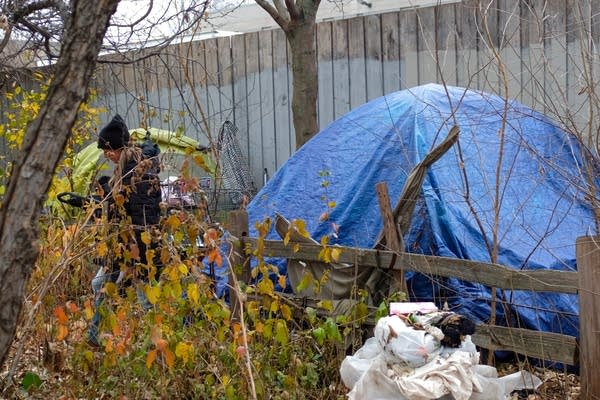
With chronic homelessness persisting, large encampments have reemerged across the Twin Cities, not only as last-resort shelter, but as places where people can remain in community and visible to outreach workers. Some of these sites have drawn urgent safety concerns, like the fire in the encampment near the intersection of 14th Avenue S. and E. 29th Street and more recently, a mass shooting at the encampment on Minneapolis landlord Hamoudi Sabri’s property on E. Lake Street. Another encampment near St. Paul’s Pig’s Eye Park continues to grow, with as many as 350 people living there.
The city of Minneapolis has repeatedly cleared out encampments and claimed that it offered housing and treatment services to the occupants. However, the demand is much higher than the supply. On Dec. 10, Hennepin County, which covers most of the metro area, reported just 65 available beds that morning.
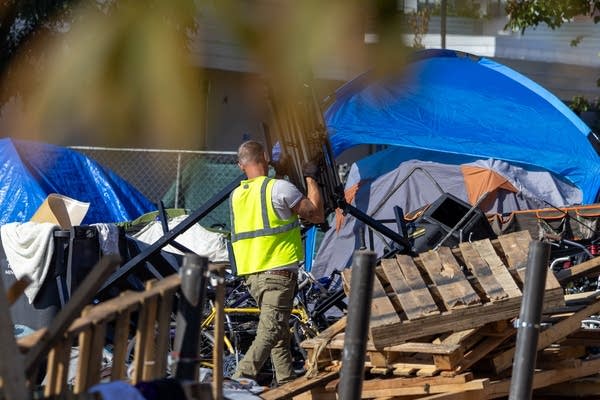
Advocates say that clearing visible encampments drives people further from services and support, and prevents them from being counted in the county’s by-name data.
“If you’ve lost track of someone and you don’t know where they are, or they’re being pushed around from location to location, then it’s very, very hard to be able to make that connection with that person and get them to the provider to then get them into housing,” said John Tribbett, service area director at Avivo, a nonprofit that provides addiction treatment, job training and housing services, as well as low-barrier and culturally responsive shelters at Avivo Village in Minneapolis and St. Cloud. Tribbett oversees street outreach, harm reduction programs, Avivo Village emergency shelter operations, and housing initiatives.
Tribbett added that while there are not enough shelter beds, at the same time, a reductive narrative persists that people were offered services and chose not to take them.
“It’s just simply not the case that there is enough availability; there’s not enough services, and a short arc of time to get everyone realistically into a housing opportunity or shelter,” he said.
What has and hasn’t worked
Still, “there’s a lot of progress, if you look back 10 years ago, to where we are today,” Tribbett said.
A combination of approaches has helped serve the especially complex population of chronically homeless, he said. They include “low barrier” or “no barrier” access to shelters, in contrast to past restrictive practices like requiring a Breathalyzer before entry; harm reduction-oriented services and housing-first practices, street outreach teams, and shelters that offer a combination of mental and physical health and addiction treatment services.
Kelina Morgan is vice president of housing services at Sabathani Community Center in south Minneapolis. Sabathani offers a Continuum of Care program — HUD-designated regional bodies that oversee homelessness funding, coordinate services and set strategy across providers — that specifically caters to the chronically homeless. The program is small, serving about 20 clients.
Clients pay 30 percent of their income for rent, and the program pays for the rest. If the client has no income, the program pays for the rent entirely. Sabathani also provides education on housing and tenants’ rights, and once the person is housed, supports them in applying for apartments and with rent.
“We ultimately want to be a resource that doesn’t just house but that we provide, like a wraparound connection or referral to any needs in the community that’s going to help provide the stability for that household,” Morgan said.
When addressing chronic homelessness, such wrap-around services and stable housing are essential, Morgan said.
However, the system isn’t without flaws. “Once you hit the homelessness system, it is just its own world, and it’s easy for people to just get lost and mired into it,” Tribbett said.
He pointed out that in addition to imperfect data that don’t reflect the true number of chronically homeless people at a given point, there are structural and bureaucratic barriers, such as restrictive shelter admission requirements, complicated processes, and high wait times that make it difficult for many to seek shelter, often driving them away from shelters for good in anticipation that they will not get a bed.
Funding changes create uncertainty
After COVID-era funding for the American Rescue Plan, which provided billions for housing and homelessness relief, ended last year, this year has brought further proposed changes and cuts to federal funding for many housing services.
In November, the Trump administration announced funding changes to HUD’s Continuum of Care program, the largest federal program that provides funding to communities for addressing homelessness.
The new policy would cap the portion of CoC funds that can be used for permanent supportive housing at 30 percent, down from about 87 to 90 percent historically, and shift the remaining money toward short-term and transitional housing with requirements tied to work, treatment or other conditions.
This would mark a major departure from the long-standing “housing-first” model, which prioritizes moving people directly into stable, permanent housing without preconditions. It also proposes a competitive system, giving federal officials greater control over which programs get funded and under what conditions.
The National Alliance to End Homelessness predicts that at least 170,000 people in the country would lose their supportive housing due to the shift. According to the group, 48 percent of permanent housing beds in Minnesota are funded through Continuum of Care. This could cause nearly 4,000 people in the state to lose housing, and more than $26 million to be cut.
In response, lawmakers like Sen. Tina Smith, D-Minn., signed a letter last month urging the Trump administration to reverse those changes, writing that they would especially impact those who are chronically homeless. Several lawsuits were also filed.
“This … undermines local decision-making authority, and ignores decades of research that has proven that permanent supportive housing and rapid rehousing are less costly and more likely to be successful in providing long-term stability than other strategies, particularly for chronically homeless people and families,” the letter reads.
Smith told Sahan Journal that the changes will have a “devastating impact” on Minnesotans experiencing homelessness. She said Continuum of Care programs provide a holistic approach, helping people find stable housing while also connecting them with resources and helping them tackle issues like substance use.
“It’s throwing out the door 20 years of experience and knowledge and saying, ‘No, we’re not going to do it that way anymore.’ And it is kind of shocking,” she said of the cuts.
Following the legal and political backlash, HUD temporarily withdrew the funding notice as of Dec. 8, just hours before a major court hearing, saying it will issue a revised version after review. But the move has sowed deep uncertainty among homeless-service providers and advocates about when and how support will be restored, Politico reported.
Morgan said that the federal government moving away from funding permanent housing isn’t the solution. She said it takes time for people to get used to being in an apartment to begin with, and that under the new changes, people will be back on the streets again.
“There’s a period of time where you really don’t establish yourself as being housed, and that could be up to two years, like, ‘I still got to keep my bags packed, because, you know, anything can happen,’” she said.
The Continuum of Care Pathways program through Sabathani Community Center is entirely funded with HUD dollars. Morgan said her program has funding through most of next year, but after that, its future is uncertain.
“Right now we are in the mindset that we continue until we’re told not to, while still knowing that there is that potential that that could be sooner than later,” she said.
To secure its contract for 2026, the program had to scrub any language that referenced diversity, equity and inclusion efforts, which Morgan said was challenging, as Sabathani predominantly caters to the Black community. According to Wilder, 77 percent of those experiencing homelessness in the Twin Cities metro are people of color.
But she said they concluded that it wouldn’t impact Sabathani’s mission, so they signed the contract to continue providing services.
At Agate Housing and Services, Executive Director Kyle Hanson is “deeply concerned” about these changes.
“They’re really talking about some significant, permanent shifts that would reverse decades worth of work that we’ve done in our communities to really get people stabilized,” he said. Hanson said that with federal funding in threat, nonprofits like his will face increased pressures.
But it isn’t just direct funding changes that affect nonprofits. Other sweeping cuts to health care funding have forced nonprofits like Avivo to redirect their limited resources and capital to the most immediate need, such as when SNAP benefits were cut and then threatened with a pause during the recent government shutdown. “So then you’re not looking at doing further programming, or even really putting as much as you should into your current programming, because you’re having to do these triage crisis moments,” Tribbett said.
“We’d be stuck with working a lot more with money within the state, but, realistically, the pot in the state is only as big as it is,” he said.
Native population is the most impacted
Wilder collects one of the state’s most comprehensive data in its Minnesota Homelessness Survey. Conducted every three years, it goes beyond the HUD point-in-time count, offering a fuller picture of who is unhoused, why, and for how long.
In its most recent survey in 2023, Wilder found that the majority of Minnesota’s unsheltered population is stuck in long-term – which Minnesota defines as being homeless for a year or longer or four or more times in the last three years – and chronic homelessness.,
It is also the only statewide study in the country that includes reservation-level data, gathered in partnership with tribal nations.
The data emphasize the overrepresentation of Native Americans in chronic homelessness compared to the proportion of their population. They represented 30 percent of adults interviewed in the 2023 Minnesota and Reservation Homeless Studies despite making up just 2 percent of Minnesota’s adult population. Nearly half of them were located in Hennepin County. Seventy percent of the homeless population is between ages 24 to 54, and a majority have been unsheltered for the most part.
Historical and generational trauma, mental health disorders and substance abuse, and a lack of affordable housing are some of the many factors that have put this population in a cycle of homelessness. The study found that Native Americans experiencing homelessness in the Twin Cities would need to earn 5.5 times more per month than they currently do to cover the cost of rent.
“We’re seeing increases in that long-term homeless population across all populations that we’re looking at,” said Decker Gerrard, co-director of the Minnesota Homeless Study and the Reservation Homeless Study. “The fourth biggest issue as a population, besides physical health, mental health and chemical dependency that we really have seen over time, is childhood trauma and also current trauma in their lives.”
At the American Indian Community Development Corp. (AICDC), a lot of CEO Travis Earth-Werner’s efforts have been directed toward serving those experiencing chronic homelessness in the community. Earth-Werner said this community faces many barriers in accessing and maintaining stable housing, adding that denial of help is one of them.
“These individuals are often told no, and when you’re told no enough, it’s hard to continue to ask if you already know what the outcome is going to be,” he said. “The hopelessness, the feeling that nothing’s going to change, even if I try my best.”
In addition to offering comprehensive services such as street outreach, round-the-clock shelters, harm reduction, and abstinence-based housing, AICDC’s work stresses the importance of culturally rooted traditions, such as offering tobacco, doing a prayer, holding a sweat lodge ceremony, and even fostering community-based living to build trust and break the cycle of hopelessness.
“Housing doesn’t change behaviors. It just changes the situation and where they’re at,” Earth-Werner said.
The path ahead
Every housing and outreach professional Sahan Journal spoke to acknowledged the concerted effort to mitigate homelessness in all shapes and forms, while also acknowledging systemic gaps that have led to chronic homelessness becoming a sustained issue.
“The folks that are experiencing chronic homelessness, probably had a system fail [them] at some point,” said Werder, of Hennepin County. “It could have been our system. It could have been a different system. But there’s a reason why they’re stuck in this space, and there’s probably barriers to housing that they need support in breaking down.”
Even though the county’s goal to end chronic homelessness by this year could not be met, the county will “keep finding those light bulb moments of what works for someone,” Haidos said.
Dawn Moskowitz, who works as a data coach and performance advisor on Community Solutions’ Built for Zero team, said that it’s encouraged for communities to set ambitious goals.
“You go farther faster when you have a shared goal that people are aligned around,” she said. “You will learn more from it. You will get more done.”
Haidos added that the county’s next phase of work will center on identifying what works for chronically homeless residents by analyzing individual-level data more consistently, especially the reasons people are denied housing, to pinpoint specific supports each person needs and spot broader system changes that could improve long-term outcomes.
The goal, she said, is to find where the right intervention and the right staff connection can help someone exit homelessness for good.
“I want to stay focused on our successful outcomes,” Haidos said.


 English (US) ·