
ARTICLE AD BOX
Minnesota has an ambitious goal to get all of its electricity from carbon-free sources by 2040. Utilities are retiring power plants that burn coal and are adding new wind and solar energy.
But without batteries, the electricity generated by wind and solar farms must be used as soon as it's produced. That’s not always when it’s most needed.
"Think of the battery as like a stockbroker who can absorb excess energy, or buy that electricity when it's really cheap, and then discharge that energy when the demand is high, when electricity might be more expensive,” said Aaron Hanson, energy program specialist with the University of Minnesota's Institute on the Environment.
Batteries that store electricity and release it on demand are becoming an increasingly important part of the transition to clean energy.
Minnesota regulators recently approved a large standalone battery system in Byron, west of Rochester, that will connect directly to the grid rather than a power plant. Connexus Energy’s standalone battery system in Vadnais Heights began operating in May. And more solar and wind projects are now being built with an energy storage component.
"Battery storage technology is here. It's real. It’s mature,” said Allen Gleckner, chief policy officer at the nonprofit Fresh Energy. “It's operating in Minnesota right now."
Batteries can provide power when solar or wind farms aren't producing any, without requiring fossil fuels, Gleckner said.
"It's sort of the first wave of new technology that we're seeing to really allow us to go to greater and greater percentages of wind and solar on our grid,” he said.
John Farrell, director of the Energy Democracy Initiative at the nonprofit Institute for Local Self-Reliance, said batteries potentially could allow utilities to avoid using “peaking” plants to meet surges in demand. Those typically burn fossil fuels and are expensive to operate, he said.
Batteries also could forestall the need to make big investments in the electric grid that can drive up rates, Farrell said.
“So there are some exciting ways they can really help keep energy more affordable,” he said.
Xcel Energy leans into battery storage
Earlier this month, Xcel Energy announced it wants to double the amount of lithium battery storage it already planned to install next to its Sherco coal-fired power plant in central Minnesota.
Xcel plans to retire the coal plant by 2030 and is building a massive solar project at the site. The batteries would allow Xcel to store energy produced at its wind, solar, nuclear and natural gas plants across the Upper Midwest.

The Minneapolis-based utility also wants to create a network of batteries across the state. The batteries — roughly the size of shipping containers — would be located at businesses, industries or nonprofits that agree to host them.
Executive vice president Ryan Long said the batteries would allow Xcel to store electricity when the customer doesn't need it or when it's especially cheap to produce, like the middle of the night when there’s lots of wind energy and demand is low.
"So then we're able to store that and release it to the grid during peak times in the afternoon, when we see energy prices increase,” Long said.
Some battery proponents say they also could reduce the need for expensive upgrades to the electric grid to meet the growing demand for electricity from homes, businesses, industries and data centers.
Pier LaFarge is co-founder and CEO of Sparkfund, Xcel's partner on the battery network proposal. He calls batteries the "magic sauce" of the energy transition, because they allow a utility to sell more electricity over the existing grid.
"If you can charge a battery when there's plenty of electrons available and discharge them when there's a peak, you can have economic growth and put downward pressure on rates, because you're selling more electrons over the infrastructure you have,” LaFarge said.
Not everyone is on board with Xcel’s proposal, which needs the approval of state regulators. Some take issue with the idea of a utility monopolizing — and profiting from — a storage network, instead of opening it up to competition to build and own the batteries.
Farrell said the idea of putting small-scale batteries close to where people use energy makes sense. But he said he’s skeptical that Xcel will use the system effectively to save customers money.
And Farrell thinks the program should be rolled out faster than Xcel’s proposal for up to 200 megawatts of storage over three years.
“We've seen dramatic upward pressure on electricity prices and electric bills lately,” he said. “I think we should actually be looking at deploying this faster.”
Solar and batteries provide resilience
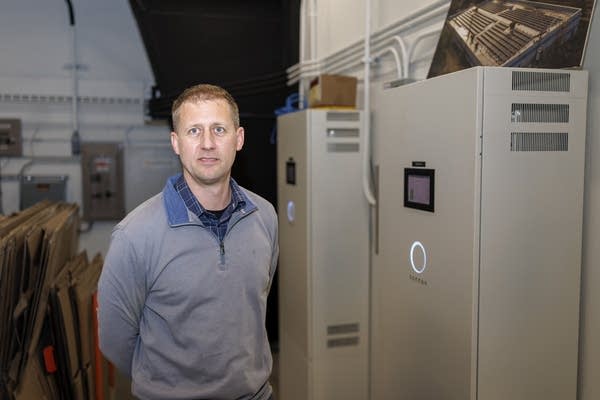
In a back room at the Regional Apprenticeship Training Center in Minneapolis are four upright metal boxes that look like big gym lockers, each with a small display screen.
The batteries are connected to a rooftop solar array. If the power goes out, the training center can use electricity stored in these batteries. It can also draw down the batteries when demand for electricity spikes.
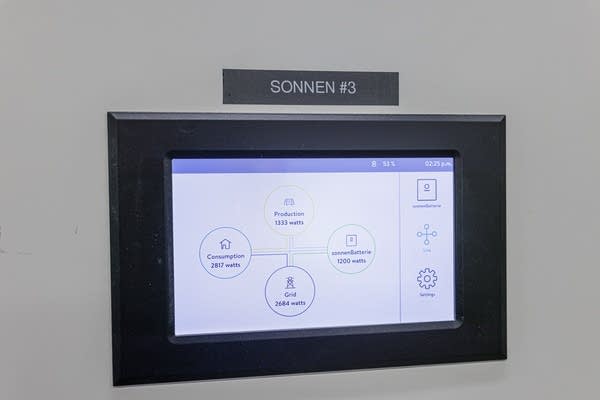
The training center was founded by Renewable Energy Partners, a solar development company, to teach people skills to work in clean energy jobs. The solar and battery project simulates a virtual power plant, and also serves as a teaching tool for the center.
Senior project manager Jacob Bechtold said more of the company's solar customers are asking to add energy storage too. He said falling prices of batteries and federal tax credits for energy storage projects are driving demand.
"We're assuming that a year from now, about half of our projects will have batteries,” he said. “That's a pretty bold assumption. But we think it brings value to all of our projects."
Batteries do add upfront cost. But they can keep a home, business or school operating during an outage. And on a larger scale, they can provide other benefits — like making the power grid more reliable and resilient, Hanson said.
“By enabling those renewable sources where the fuel inputs are free — sunlight and wind — we can hope to see that it'll actually bring affordability into play as well,” he said.



 English (US) ·