
ARTICLE AD BOX
Lt. Cmdr. Melissa de Vera remembers returning home with her sister after school to notices hanging on her family’s door. And like many others her age in the area, she remembers those notices telling them not to drink water from the faucet, stating it was not safe for consumption that day.
“There were a lot of us coming home to these notes and just not really understanding what they meant,” de Vera said. She grew up in Fallon, Nev., which she says is known for having elevated levels of arsenic in the water.
“It didn't hit me till years later that also was really, really odd and probably not very normal for a community to have notices like that,” she said.
De Vera says memories of those notices left behind on her door and a lack of public education in what those notices meant are what guided her to a career in water and sanitation services.
“Those experiences, I think that those are the ones that really drove my interest in water and drove my interest in really figuring out a way that I could work for the public,” de Vera said.
De Vera, a member of the Chippewa Cree Tribe of the Rocky Boy’s Reservation, currently lives and works in Bemidji as assistant director of operations at Indian Health Service’s Division of Sanitation Facilities Construction. The division is responsible for delivering engineering services and sanitation facilities to Native communities nationwide. She also serves as a lieutenant commander with the U.S. Public Health Service Commissioned Corps.
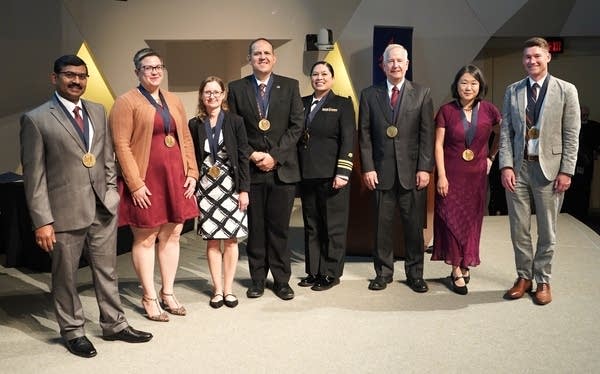
She was recently announced as one of the 2025 Arthur S. Flemming Award recipients. The award honors federal employees whose achievements in science and leadership have benefited the nation.
According to a press release, her work helped to “enable [Indian Health Service] to deliver $3.5 billion in sanitation projects under the 2021 Bipartisan Infrastructure Law.”
In Minnesota, at least three projects have been funded through the bipartisan infrastructure law.
“Money was directed to the Indian Health Service for the purpose of installing or improving water, wastewater and solid waste infrastructure for tribes,” de Vera said.
She was recognized for her work in strengthening the Indian Health Service’s Sanitation Facilities Construction program through leadership and strategic partnerships to recruit for vacant positions.
“Getting this huge injection of funds was definitely something that I think my division was very excited about, but also it was definitely going to be a challenge,” she said. “So, what we really had to look at was, how are we going to fill positions when we already kind of have chronic vacancies?”
De Vera says she focused on recruitment and retention, forming partnerships with the Department of Energy’s Oak Ridge Institute for Science and Education and the American Indian Science and Engineering Society, or AISES.
Her recruitment filled positions through internships and collaborations to assist in delivering water sanitation projects to American Indian and Alaska Native communities.
“What I see this work really doing for Native communities in the long run is hopefully putting more Native American engineers in positions to be able to assist the tribes, and to be able to assist them in a way that helps them make informed decisions about their water and their sewer and their solid waste infrastructure,” de Vera said.
‘Things are really going down the right path’
Before her career in public service launched, de Vera says she spent years working miscellaneous jobs. At the age of 33, she entered community college while working as a receptionist for Indian Health Service in a local office in Nevada.
During her time at community college, de Vera says she took a variety of classes to discover her skillsets. Living in the high desert, a region where there “is not a lot of water,” she took an environmental studies course.
“I started thinking about water a little bit more, and started looking at, you know, what type of fields worked with water. And so that's when I started delving into looking at engineering degrees,” she said.
De Vera then transferred to the University of Nevada, Reno. She left her job at Indian Health Service, though she says she received a scholarship from the organization to help fund the rest of her college education.
“I remember just dropping to my knees, getting that letter,” de Vera said, her voice filled with emotion. “I felt like, oh my gosh, you know, things are really going down the right path.”
After a total of nine years of pursuing higher education, de Vera graduated with a degree in environmental engineering. With a service commitment to Indian Health Service, she moved to Bemidji to begin her career as a junior field engineer at the organization’s local office.
Although recognized for her work in recruitment and retention of positions at Indian Health Service, de Vera says she also aims to be a role model for those considering a career in environmental engineering. She attended this year’s national AISES conference in Minneapolis.
“I couldn't help but look out at the crowd and just wonder if — is there a student out there that's going to totally be in my position several years from now?” she said. De Vera says that through the partnerships she has formed, she hopes that doors have opened for those interested in similar career pathways.
De Vera was recognized among other awardees on Nov. 2 in Washington, D.C.
Chandra Colvin covers Native American communities in Minnesota for MPR News via Report for America, a national service program that places journalists into local newsrooms to report on undercovered issues and communities.


 English (US) ·