
ARTICLE AD BOX
The Minneapolis City Council passed an ordinance Thursday that its authors say aims to require a more humane and public health-centered response to homeless encampments, including how they are closed.
Prior to this ordinance, the only official policy in place regarding encampment response was a police order to break up camps that begin to form, according to city spokesperson Jess Olstad.
But the new ordinance faces a likely veto from Mayor Jacob Frey.
The ordinance itself codifies the city’s obligation to provide portable bathrooms, hand-washing stations, trash collection services and overdose reversal medicine within 10 days of an encampment forming with more than 20 people present.
It also mandates people are provided a week’s notice before the city shuts down the encampment, barring emergencies that would require immediate closure.
Some opponents of the ordinance say it incurs costs that have not been budgeted for, while advocates for people experiencing homelessness say the ordinance, while better than no policy, does not go far enough in advancing long-term solutions.
Supporters on the council say it’s necessary for shifting the city’s approach in a different direction.
“The city’s current approach to encampments fails to address public health concerns and fails to recognize the humanity of our unsheltered neighbors. It also leaves neighboring residents frustrated and confused,” co-authors Aisha Chughtai, Aurin Chowdhury and Jason Chavez said in a joint statement.
“This policy works to create a consistent codified response that is less traumatic and treats unsheltered homelessness as what the city has declared it, a public health crisis.”
A spokesperson for Mayor Jacob Frey said Frey intends to veto the ordinance.
“Once shelter and services have been offered, encampments should be closed,” Frey said in a statement. “We’ve seen what happens when encampments grow, and I can’t support an ordinance that encourages more of them. They’re not safe or healthy for anyone involved, and they end up hurting the very people we’re trying to help.”
Unsheltered homelessness a public health emergency in Minneapolis
“We’re not saying let’s keep the encampments. We’re saying that if you have 25, or 30 or 40 people … you cannot hold back Porta Potties. You cannot hold back trash pickup,” said Council member Jamal Osman, who voted in favor of the ordinance and represents parts of the city where homelessness has been more visible.
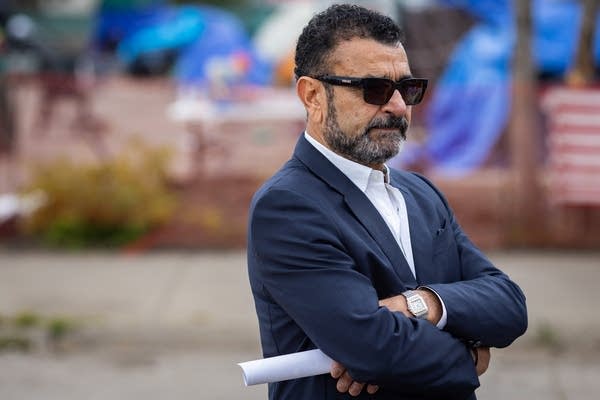
When the city council was debating whether or not to authorize legal action against Hamoudi Sabri, the real estate developer who was served public health citations after allowing people to camp on his property, Osman said the city did not hold itself to the same standard. He said the city has declined his ask for portable bathrooms when encampments swelled in size.
But with this ordinance, he said, “I don’t have to go to the mayor every time and beg for services that we deserve in Ward 6. I need to be able to tell him, ‘hey, this is the policy that you need to follow as the leader of the city.”
In 2023, the city of Minneapolis declared unsheltered homelessness a public health emergency. Guidance from the Minnesota Department of Health recommends portable toilets, handwashing stations and waste removal at encampments to prevent the spread of infectious diseases.
“To promote ongoing public health efforts, enforcement actions should consider the intention of minimizing the disruptions to people’s property (including medications); support networks; and connections to services,” the guidance states.
The ordinance requires the city to provide information about warming or cooling centers and coordinate with partners over access to housing services.
During closures, it calls for the “minimum number of law enforcement personnel” needed to safely respond alongside mental health professionals — which could include the behavioral crisis response team — and for residents to receive assistance in locating adequate alternative housing or shelter.
It also requires the city to provide free storage for belongings that is accessible via public transportation.
When the city clears an encampment or Minneapolis police officers make people move, there currently is not a place where the city will store belongings. City spokesperson Olstad said the city put out a contract request for a storage facility but it did not elicit any response.
Council needs one more vote to override veto
The council approved the ordinance by an 8-5 vote. Those who voted against it were members Michael Rainville, LaTrisha Vetaw, Linea Palmisano, Andrea Jenkins and Katie Cashman. If the mayor vetoes the ordinance, one of the five would have to switch to a ‘yes’ vote in order to override that veto.
Throughout her tenure, Cashman has more frequently voted with the progressive majority, instead of the more moderate Frey-aligned wing. At Thursday’s council meeting, she voted with the minority.
Cashman said she was concerned the seven-day window would limit the ability for city staff to take action on an encampment as it grows larger within that time.
Still, she said she supported the ordinance’s aim of reducing police hours and resources spent on encampments, as well as the shift to a response that considers mental health support.
Palmisano, who voted against it, said the ordinance lacks provisions addressing issues of trafficking and other crimes. That’s a concern that was raised by the chair of the Metropolitan Urban Indian Directors Public Safety Committee, Wahbon Spears, who opposed the ordinance in a letter to the council.
Palmisano added in the meeting: “These health and safety resources will be expensive to provide and maintain. I assume that we would have to make those arrangements to cover that in our budget.”
Olstad said the city council’s ordinance would slow down the city’s ability to close encampments and supersede parts of the police order. She said the city follows internal guidelines for closures, including aiming for a 3-day notice. However, that is not always what happens.
At a public hearing Tuesday, more than a dozen people signed up to comment on the ordinance. Several of them expressed support in the “step forward” but said it didn’t do enough to advance long-term solutions. That included community organizer Nicole Mason who advocates for indigenous community members who are disproportionately impacted by homelessness.
“Our relatives living outdoors are not choosing homelessness. They are navigating trauma, displacement, unaffordable housing and systems that have not kept pace with community needs. Yet, the ordinance focuses on restrictions and removals rather than safety, stability and pathways to housing,” Mason said. “The ordinance must be paired with actual resources, timelines and accountability measures to move forward long-term housing solutions, not short-term displacement.”
City’s primary policy is a law enforcement response
The other policy on the books — Police Chief Brian O’Hara’s order from January — directs officers to prevent encampments from forming by not allowing people to set up tents in the first place. The directive points to laws around trespassing and damage to property as grounds for citations and arrest.
Christin Crabtree, a community organizer who is part of the support network for people living outside and who has witnessed the city’s on-the-ground response, said having the city’s only policy be a police response serves to end encampments but not homelessness.
“What happens as a result is not that people get housed, but more that people are just moved from area to area and often into less and less safe conditions. It creates desperation and desperation puts people into survival mode,” she said. “What we are seeing is MPD roll up and shine bright lights on folks and take away whatever very minimal heating source they might have, oftentimes take what minimal belongings they have and people are left with nothing.”
She added that it also serves to fracture trust in the city.
“If their only experience with the City of Minneapolis is with law enforcement, that is oftentimes very unkind and gruff, then why on earth would they trust that same institution to provide them with services?”


 English (US) ·