
ARTICLE AD BOX
The Minnetonka police and fire departments are launching a new program to respond to 911 calls — one that will see drones arrive on-scene before emergency responders for some calls.
The drones will be able to send live video of a scene back to remote pilots at police headquarters.
Minnetonka Deputy Police Chief Jason Tait said Monday that emergency responders will benefit from knowing what a scene looks like before they get there.
“It slows that call down. It really gives them more information to make better decisions,” Tait said. “It’s going to be a game-changer for our agency.”
The department — like dozens of others across the state — already uses drones to aid in investigations, including searching for suspects or missing people. But Minnetonka officials say they’re the first in the state to send drones to a scene as first responders. Other cities, including Rochester, are in the process of launching similar programs.
The department has six drones docked on rooftops of city buildings. They’re manufactured by the company Skydio. Officials said the drones can reach anywhere in the city in about two minutes.
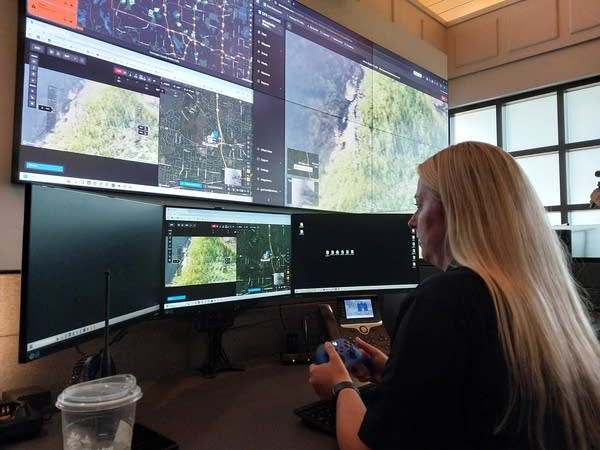
In a demonstration Monday, staff practiced a response to this scenario: a person calling 911 to say they’ve been injured somewhere along Minnehaha Creek, but they don’t know their exact location.
A pilot booted up the nearest drone and flew along the creek. A few minutes later, the thermal camera picked up a heat signature on the bank; pilots were able to radio first responders with the person’s location.
Officials said the drones can also be useful to scope out fires before the fire department arrives. And other cities that have already launched drones-as-first-responder programs have been able to resolve some calls without sending an officer — for example, sending a drone out to the scene of a reported car theft and finding that, in fact, the “thief” was a person who was locked out of their own car.
But the use of drones for policing has raised concerns about privacy and due process. In Minnesota, the American Civil Liberties Union pushed for state laws regulating the use of drones.
ACLU attorney Alicia Granse said she’s wary of new technology that makes surveillance easier, including drones.
“They’re very mobile, and they’re equipped with cameras. They could potentially… really increase the amount of information that law enforcement and the government can have about everyday Minnesotans,” Granse said.
State law limits how police can use drones. Departments can’t use drones for general surveillance. Minnetonka’s policy specifies that drones will be dispatched when calls “require timely assessment of conditions, identification of threats, or location of involved persons.”
Granse said the use of drones by police should prioritize balancing a right to privacy and a need to keep people safe. Responding to 911 calls, she said, could be an appropriate use for drones — especially if getting more information about an emergency scene helps responders make more informed decisions.
“We want everybody to be safe. And so often, when police respond in an emergency, that might not be the case,” Granse said. “And if a drone can be useful in that way, and they’re using it correctly, then I think that’s a proper balancing.”
But she said oversight will be important as the programs take off, to monitor the outcomes of using drones on communities and officers.
Minnetonka Police Chief Scott Boerboom said the department’s policies are in line with state laws on drone use, which say police can’t use drones for general surveillance. They are only permitted in situations where someone could be in danger.
“This is not about surveillance. These drones are tools for safety and emergency response only,” Boerboom said.
The department will log all drone flights in an online dashboard. The public will be able to see each drone’s flight path and reasons for dispatch. The department plans to save any video that could be used as evidence; any video that officers believe does not show evidence will be deleted after three days.
The drones will cost the city about $265,000 per year. Officials said they expect the program to save the city money in personnel costs.


 English (US) ·