
ARTICLE AD BOX
PFAS, often called "forever chemicals," have turned up almost everywhere in Minnesota — in water, soil, fish and wildlife.
Now, scientists want to know how much PFAS are in the air and how the chemicals are moving through the environment. They're using a simple and natural tool: pine needles.
It turns out that coniferous needles make surprisingly good natural air monitors. They have a waxy surface that contaminants easily stick to.
"We often find PFAS in soil or fish or water in remote areas where there's no obvious local source,” said Summer Streets, a research scientist at the Minnesota Pollution Control Agency. "Where is that PFAS coming from? It's probably coming from an atmospheric deposition."
Understanding PFAS in the air is key to knowing how the chemicals move around in the environment and how they end up in lakes, rivers and fish, Streets said.
“That air pathway is really important for moving PFAS all around the environment — not just in Minnesota, but globally,” she said.
PFAS, or per- and polyfluoroalkyl substances, are used in many different consumer and industrial products, from nonstick cookware and waterproof clothing to carpets and cosmetics.
They don't break down in the environment. Long-term exposure to some PFAS has been linked to health problems including kidney and thyroid issues, low birth weight, reduced fertility and cancer.
Scientists have studied PFAS in water, soil and fish. But they know little about how much are in the air.
Traditional air monitoring equipment is expensive and would be difficult to deploy statewide, especially in remote areas, Streets said. Then she heard about a North Carolina State University study that used pine needles.
“I thought, ‘Wouldn't this be cool? Can we do this statewide?’” Streets said.
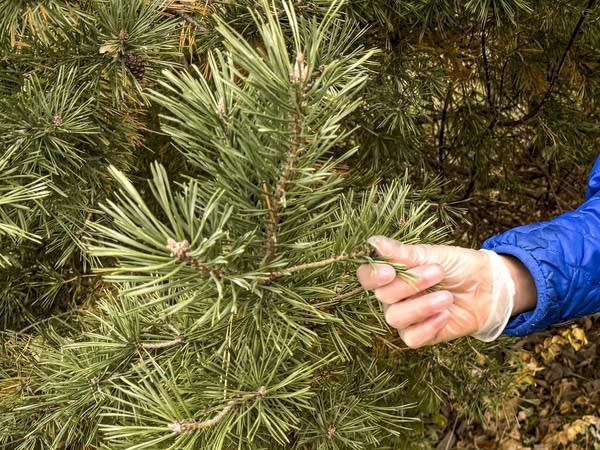
For the North Carolina study, published in 2022, researchers collected pine needles from several locations around Chemours, a PFAS-manufacturing facility that polluted the drinking water of thousands of residents in the Cape Fear region. They also collected samples near an airport where firefighting foam containing PFAS was used.
Kaylie Donelson, an environmental chemist, was the lead author of that study while she was a graduate student at NCSU. She said the pine needle testing provided a “fingerprint” showing the evolution of forever chemicals over decades.
“We could see PFAS pop up over time, and then, as they were phased out of use, we could watch them go back down,” Donelson said. “We could see the PFAS that were specific to the airport versus near the manufacturing plant, and kind of see how far those traveled.”
Donelson said her study was relatively limited, so she’s enthusiastic that Minnesota’s research project will be statewide.
“There's a lot of sources of PFAS that we know about,” Donelson said. “But I do think others could potentially be found through sampling the state.”
Streets recruited volunteers who already help monitor water quality to collect pine needles in all 87 Minnesota counties. They also recorded the GPS coordinates and a description of each location.
In the lab, scientists will test the needles for 75 different PFAS compounds, far more than they typically screen for in drinking water.
"We should be able to kind of lay that out on a map and look for hot spots, possibly,” Streets said. “If we're seeing an area where certain PFAS are very elevated, does that mean there might be a source there that we could track down and work with?"
That's valuable information as the state tries to reduce the amount of PFAS getting into the environment, she said.
Researchers also will compare the new samples with old pine needles stored at the Bell Museum in St. Paul, collected long before forever chemicals were invented.
"When did we see certain PFAS arrive on the scene? When was the first time we started really seeing PFAS out in the wider environment, away from manufacturing?” Streets asked. “There's all sorts of interesting things that we can learn from that."
Another benefit to the study, Streets said, is that the volunteers now understand more about PFAS and can help spread that knowledge.
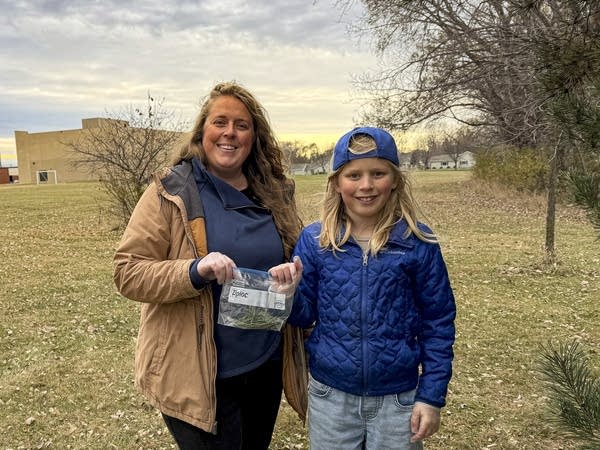
That includes Abby Wacker and her 9-year-old son, George, who collected pine needles from a tree at her parents’ home in Cokato, about 50 miles west of the Twin Cities.
"We had to just pull off the very ends off of each branch,” Wacker said. “And then we went all the way around the tree at eye level to fill a bag.”
They wore plastic gloves, so any PFAS on their skin wouldn’t taint the samples. Their clothing had been washed multiple times to avoid contamination.
Wacker, a registered nurse who works for a local public health department, said she hopes their work helps scientists better understand PFAS in the air and pinpoint places where their exposure to people can be reduced.
“Citizen science projects are so cool, because it gives us all an opportunity to participate in different projects that help better our health,” she said. “But also help us become more in-tune with nature and what's going on in our natural environment.”


 English (US) ·