
ARTICLE AD BOX
When two of their colleagues were attacked in dark-of-night shootings at their homes, many lawmakers naturally wondered whether they were also at risk and if they could do anything to reel in the political toxicity that contributed to the tragedy.
About two months later, discussions about physical security are in full swing. But some lawmakers and people close to Minnesota’s political process are also contemplating how they can steer a gentler era of political dialogue that might actually last.
A group of them accepted an invitation not long ago from Shannon Watson to firm up their commitment to do something to change the tide.
“This is a movement to honor those lost and wounded by choosing community over conflict, dialogue over division, and courage over cowardice,” said Watson, who leads the Majority in the Middle group that promotes civility in public life.
To the attendees and Watson, it was a way to show the killings of House DFL Leader Melissa Hortman and her husband, Mark, and the wounding of Sen. John Hoffman, and his wife, Yvette, weren’t in vain.
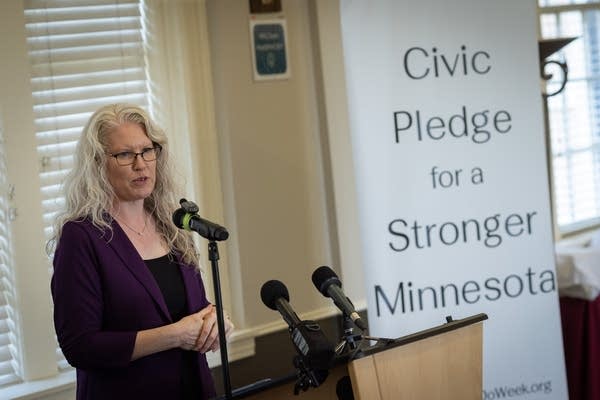
Watson invited the group to sign a pledge to stand firmer against rhetoric that incites violence. Several pairs of lawmakers – Republicans and DFLers – did that in tandem.
It hadn’t been the only gesture. Last week in Boston, Minnesota’s legislative leaders from different parties joined together on stage to urge state lawmakers from around the country to make a similar promise. They remembered Hortman at the National Conference of State Legislature’s summer gathering, saying officials should emulate her ability to work with peers across the aisle – even when they disagree.
“I’ve heard many suggest that in response to the evil that visited us, we should turn down the vitriol in our rhetoric. I think a lot of America would appreciate that. I know Melissa would,” Senate Majority Leader Erin Murphy, DFL-St. Paul, told the NSCL summit.
“But, as public leaders, we need to go deeper to understand how persistent, dehumanizing narratives and conspiracy theories in public discourse are serving movements,” she continued, “and fueling the radicalization of individuals.”
It’s a tough pitch as political rhetoric gets ever sharper on the national scene. President Donald Trump frequently dishes out insults to those who disagree with him. Some Democrats have edged up their responses to the president, sometimes matching his tough tone.
Heading into an election year in 2026 with so much on the line – the governor’s office, a U.S. Senate seat, control of both legislative chambers and more – won’t make it any easier.
A pledge to do better
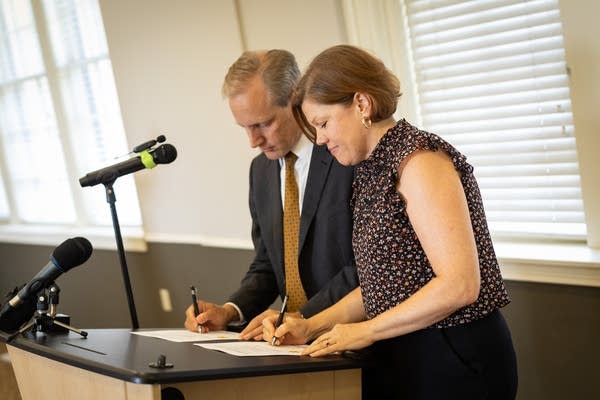
At the ceremony in late July at the Humanities Center building in St. Paul, officials walked two at a time to a podium. They picked up a pen and signed “the Civic Pledge for a Stronger Minnesota” to engage peacefully and seek out common ground. Before he signed his name, DFL Secretary of State Steve Simon said the pledge embodies the way Hortman worked.
“She could be a real fierce advocate. She could be a fighter. She could have a salty tongue,” Simon said. “But she also knew that you could disagree without being disagreeable.”
Simon said the attacks, which are believed to be politically motivated, make it imperative to reevaluate how officials communicate.
“This is not a call for people to be muted or marshmallowy or water down their opinions or their passions at all. This is just a call for people to not burn people down and not assassinate their character and not literally, literally weaponize language,” Simon said. “And as we discovered in Minnesota recently, that can happen – where language was literally weaponized.”
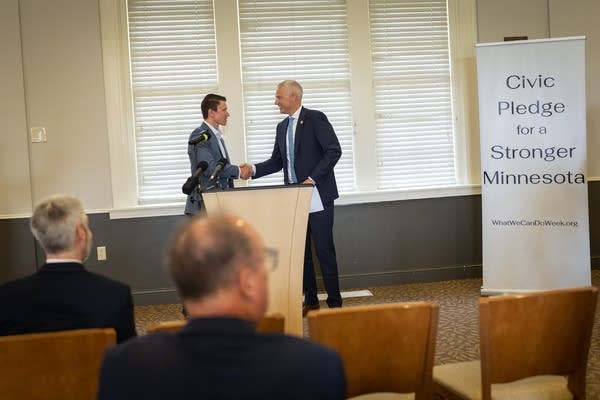
The signatories included lawmakers known as more even-keeled than some of their sometimes bombastic peers. Rep. Matt Norris, a second-term Blaine DFLer, acknowledged there are skeptics.
“It's easy to profess that you're going to change right after some sort of horrific event takes place. I think the true test will be, as time goes on, can all of us maintain that same level of commitment?” Norris said. “And that's where those of us who have traditionally done that are going to have to try to play that role of reinforcing that sort of behavior amongst all of our colleagues.”
Sen. Michael Kreun, a first-term Republican also from Blaine, said there are incentives to be a bomb thrower in politics. It can mean more air time and party backing than those who work across the aisle. Kreun hopes that can change.
“I think we have to get as a society, culturally, kind of get back to the point where we reward people that are conducting themselves in a way that polls say they want us to conduct ourselves and have a positive reinforcement. I think that will work better than a negative enforcement on bad behavior,” he said.
But it might also mean holding peers to account more often, Kreun said.
“It's easy to blame the other side and say, ‘You guys aren't doing it right.’ But it's much more difficult, but more effective, to police your own side,” Kreun said.
A fine line
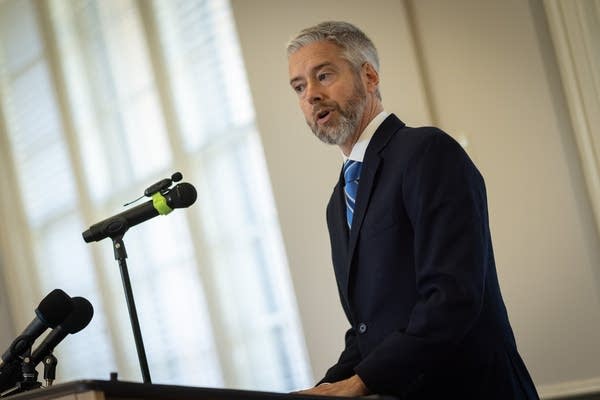
The line between pointed comments and those that incite isn't always clear. Nathan Stock, an expert in political violence and conflict resolution with CRD Connect, suggested avoiding comments that brand others as a threat.
“Referring to groups of people in ways that casts them as threatening, you know, `Such and such a group is out to destroy America. They're going to take away our freedoms. They're coming to harm our children,’” Stock said. “That kind of broad language that categorizes groups of people as a threat, that's the kind of language that some folks may hear as making violence against that targeted group appropriate.”

It’s precisely the kind of language that Minnesota’s legislative leaders are encouraging their colleagues to skip. This month, House Speaker Lisa Demuth, R-Cold Spring, and Murphy, the DFL Senate leader, spoke to thousands of state lawmakers from around the country at the National Conference of State Legislatures summit. They held up Melissa Hortman as an example.
“I hope everyone in politics moving forward will commit to a better kind of politics rooted in respect and modeled by my friend Melissa Hortman,” Demuth said.
She and Murphy said the shootings were devastating and not just in Minnesota. They’re hopeful their calls for cooler discourse will resonate around the country.
“I have been, since June 14th, hearing from leaders from different states across the country that June 14 was and is an inflection point,” Murphy said. “But I think it's important for us to say out loud, ‘It's only an inflection point if we treat it that way.’”


 English (US) ·