
ARTICLE AD BOX
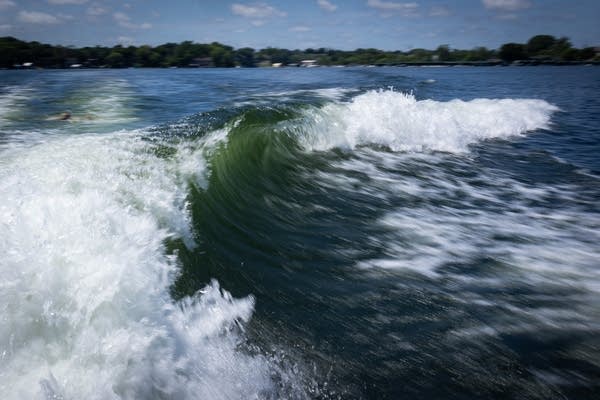
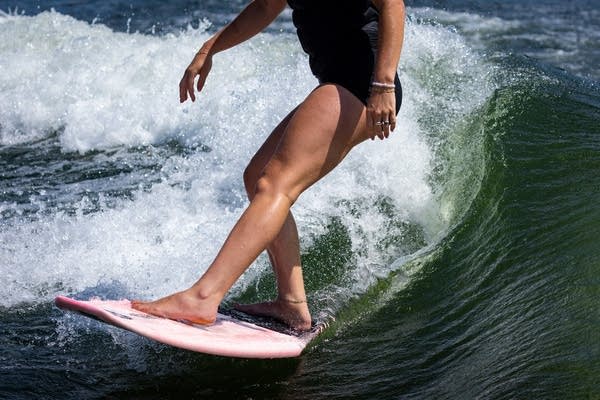
For some Minnesotans, it’s the ideal way to spend a summer day on the lake: wakesurfing a perfectly curled wave behind a powerboat with no worries of getting tangled in a tow rope or breaking ribs in a wipeout.
Others see the sport as a menace — powerful wake boats generating strong waves that pound shorelines, pummel lake bottoms and threaten the health of Minnesota lakes.
Newly released research from the University of Minnesota won’t end that debate, but the study offers a deeper look at the trouble below the surface when wake boats pass over at shallower depths.
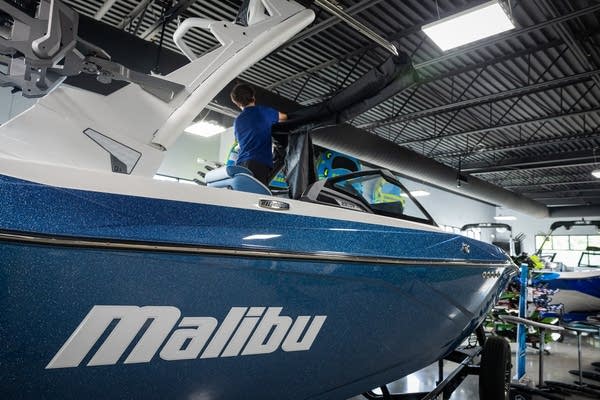
The findings may revive calls for statewide restrictions on wakesurfing. They’re also likely to churn up the ongoing debate over the state’s changing lake culture and who gets to shape it.
“One thing we hope this study does is just gets people thinking,” said Jeff Marr, lead researcher and associate director of engineering and facilities at the St. Anthony Falls Laboratory, which conducted the study. “They know their boat’s producing waves, but it's also having a big impact under the water.”
Fun sport or growing threat?
Wake boats have specially designed hulls to create a large wave for surfers to ride. Many have a ballast tank that can be filled with water to add extra weight to create a perfect wake. They typically travel at 10 to 12 mph, about half of the speed required of waterskiing.
Wakesurfing caught on more than a decade ago and has exploded in popularity in recent years. It’s been marketed as a low-impact sport that almost anyone from kids to grandparents can manage safely. Surfers are closer to the boat than in waterskiing and can talk to folks in the boat.
“It’s easy on the body. It’s social,” said Adam Fletcher, salesperson with Minnesota Inboard Water Sports, a boat dealership with operations in the Twin Cities and central Minnesota. “Grandpa can go out and surf, and not hurt his back and knees. It’s just fun. When you crash going 10 miles an hour, it doesn’t hurt.”
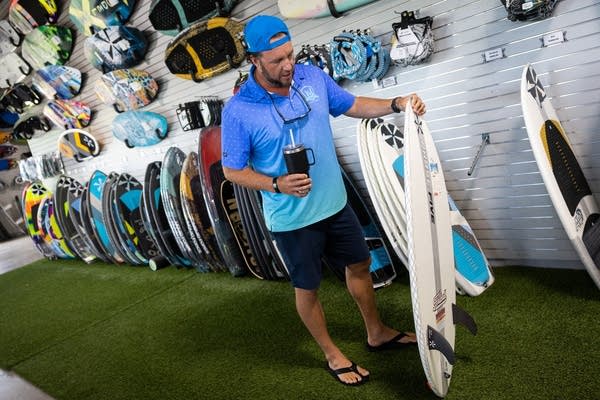
Detractors have pushed back, arguing that while the wake boats might be fun for some they end up eroding shorelines, damaging water quality and disturbing other lake users with the big wakes they create.
The new U study didn’t weigh in on lake culture, but it found reasons to be concerned that wakesurfing in too-shallow depths could harm a lake’s water quality.
Researchers concluded that in depths of 9 feet and 14 feet, the forces created by wake boats operating in surfing mode stir up sediment — tiny particles of sand, silt, clay and organic matter — from the lake bottom and suspend them in the water, turning it cloudy. That makes it more difficult for sunlight to penetrate, potentially affecting fish and plants.
Sediment also contains phosphorus, which can spur the growth of algae blooms that turn the lake green.
The report recommends that while operating in surfing mode — a slower speed that creates a large wake — boats should stay in at least 20 feet of water. That’s twice as deep as the recommendation in a study backed by the boating industry.
The industry likely will push back on the U findings as it did on a 2022 study by the St. Anthony Falls Lab that concluded wake boats should stay 500 feet from shore to minimize environmental impacts.
The Water Sports Industry Association, which represents manufacturers of tow boats and equipment, has called that report flawed and unreliable. The group says wake boats that stay 200 feet from shore and operate in 10 feet of water or more do not affect the shoreline and have minimal environmental impact.
The National Marine Manufacturers Association has supported laws requiring a 200-foot setback in several states, including Georgia, Tennessee, South Carolina and Alabama.
‘A lot of turbulence’
The St. Anthony Falls Lab study is the first to closely analyze what happens under the surface when different types of recreational boats travel at different speeds.
“We really dug into what’s actually happening when a boat is moving along,” said staff researcher Andy Riesgraf.
In 2022 and 2023, the team tested seven models of motorboats by driving them over sensors placed at the bottom of Lake Minnetonka, at different depths.
They tested both traditional power boats and wake boats in common operating modes. For traditional boats, that meant a leisurely cruising speed and a faster planing speed, common with pulling someone on water skis or a tube. The wake boats were tested at planing speed and a slower mode that creates a large wake for surfing.
The researchers found the boats created three distinct types of action: pressure waves created by the bow and stern of the boat as it displaces water, transverse waves that travel in the same direction as the boat, and propeller wash — a chaotic jet of water pushed by the rotating propeller.
All the boats created bow and stern waves that can disturb the lake bed, Riesgraf said. But it was the other two types — transverse waves and propeller wash — that suspended sediment in the water. Those are created by traditional boats at slow cruising speed, and wake boats in surfing mode.
The report recommends traditional boats stay a minimum of 10 feet of water while cruising or planing. If they must go closer to shore, they should go as slowly as possible.
However, at both 9 feet and 14 feet, the wake boats stirred up the sediment on the lake bottom and suspended it for several minutes.
“Some of the finer material is really slow to settle,” Marr said. “And if it gets really worked up into the water column, it can actually prevent light from getting far down into the lake. The nutrients in the water can lead to algae blooms, which can further reduce water quality.”
For the second year, the team added underwater cameras and aerial drones to capture the boats’ effects. In one video, a wake boat passes overhead in 9 feet of water. The scene underwater becomes chaotic.
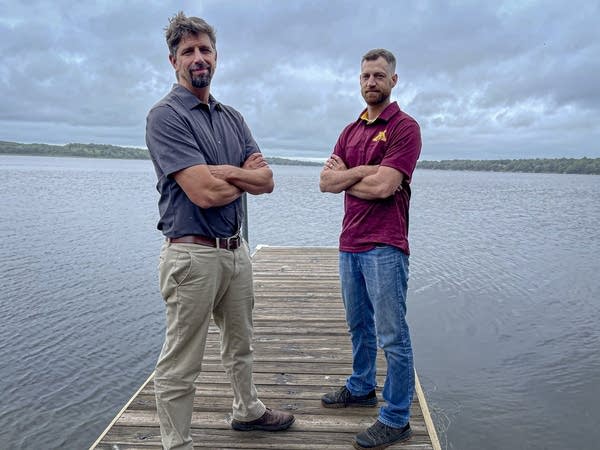
He noted that some of the underwater video footage shows fish swimming in front of the cameras — a reminder that there’s a whole other environment below the surface.
“You see a lot of turbulence, and you see the bottom sediments, we think sand, shells, being suspended in the water,” Marr said. “You see vegetation, even root masses moving by the camera.”
The drone video illustrates the problem of a boat making repeated passes over the same part of the lake, as a stirred-up cloud of fine particles lingers.
“If there are a lot of boats disrupting the bed, that’s a noticeable impact that people that are using the lake will see,” Marr said. “It reduces their experience of being on the water. It also degrades the quality of the lake.”
‘Absolutely one of the biggest issues’
Minnesota doesn’t have statewide rules governing wakesurfing, and the Minnesota Department of Natural Resources says it doesn’t collect information on wakesurfing complaints.
The DNR does have a campaign called “Own Your Wake,” which encourages all boaters to use common courtesy and be aware of the damage wakes can do.
State lawmakers have debated several wakesurfing bills in recent years but they have failed to pass.
Rulemaking is left to local and county governments and conservation districts, although only two Minnesota lakes have year-round restrictions on wakesurfing.

Last year, Cook County adopted an ordinance that effectively bans wakesurfing on Caribou Lake in northern Minnesota near Lutsen. The Twin Cities suburb of Shoreview also prohibits “bladder” boats that artificially increase wake size on Island Lake.
Vermont, Maine and Oregon have adopted laws restricting wakesurfing. Communities in Wisconsin have enacted local ordinances affecting hundreds of lakes, but some of those are now facing court challenges.
“I just don’t think there's enough information out there to start just arbitrarily throwing out new laws and regulations to kick people off the lake or not let them use the boats that they've purchased or want to use with their families,” said Fletcher with Minnesota Inboard Water Sports.
Wake boats work best in deeper water so that’s where most boaters stay anyway, he said. Businesses, he added, work hard to educate new owners about safe operations and good lake etiquette, including staying away from shore, not making repetitive passes and not blasting music.
Fletcher thinks there should be more research before adopting any new rules.
Some lake advocates, though, say self-regulation isn’t enough.
Wakesurfing is “absolutely one of the biggest issues that lake associations are dealing with,” said Joe Shneider, president of the Minnesota Coalition of Lake Associations.
Some property owners are calling for restrictions on the time of day that wake boats can use the lake, Shneider said. Others want to see certain parts of the lake designated as off-limits to wake boats because they’re too shallow or narrow.
“We’re not talking about banning boats. We’re not talking about restricting boats,” he said. “We’re talking about activities that impact what can be done on the water, and how the water, how the lake is affected by those activities.”
Shneider said he prefers a statewide policy, rather than actions by individual lakes.
Wakesurfing is one of the most talked-about issues on lakes of all sizes, said Jeff Forester, executive director of Minnesota Lakes and Rivers Advocates, a nonprofit that represents lake associations and property owners.
“They’re all seeing impacts to recreation, to lake sediments, lake beds, shoreline, damage to property. It makes it difficult to fish,” he said. “It’s a real issue, and it’s very widespread.”
Forester sees education as a solution to the conflict. Wake boats create better waves in deeper water, so it’s to a surfer’s advantage not to get too shallow, he said.
“I think people get it once they know it,” he said.
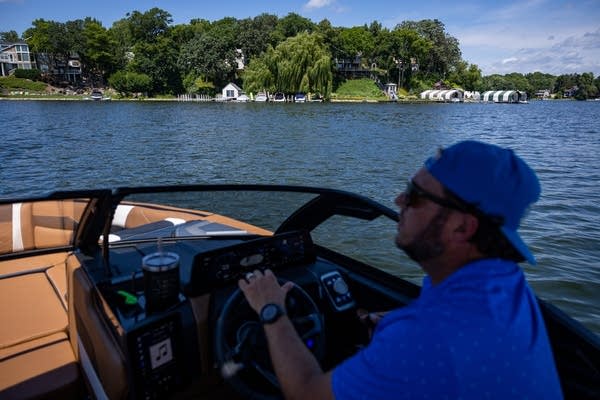
Forester’s organization creates lake maps to help guide wakesurfers that show areas at least 500 feet from shore and at least 20 feet deep. He said those maps have helped reduce conflicts with other lake users and problems with shoreline erosion.
With funding from the state’s Environment and Natural Resources Trust Fund, the U of M researchers have started gathering data for a third phase of the study. It will focus on the impact of boat and wind waves on the environment close to shore, including plants.
“Our use of those lakes is a tremendous opportunity, but it’s also something we need to keep in mind,” Marr said. “I hope this study kind of shines a light on that. Then we can do some more learning as a state about what those impacts are, and how to use lakes safely.”


 English (US) ·