
ARTICLE AD BOX
The call came into Hennepin County dispatch at 1:13 p.m. on Monday.
A supervisor at the U.S. Department of Homeland Security, which oversees ICE, told the dispatcher he needs “assistance immediately.”
He said Minneapolis police weren’t picking up their phone: “We only have a few officers, but we have 60 to 70 agitators that are fighting them.”
It was near the corner of 29th Street and Pillsbury Avenue South in Minneapolis that activists just minutes earlier had noticed two ICE agents attempting to arrest a woman in what appears to have been a traffic stop.
Activists, who have been working to impede ICE operations in the Twin Cities since the federal government announced an immigration enforcement surge at the beginning of the month, started to gather at the intersection, joined by neighbors and passersby.
Videos shared with MPR News show the agents struggling with a woman on the snowy boulevard and then restraining her on her stomach as bystanders hurled snowballs, ice and verbal abuse at them.
The agents dragged the woman across the road towards their vehicle but were blocked by protesters. The agents released the woman as they hurried to their vehicles. Witnesses say she wasn’t arrested in the end, but that at least three other people were.
This has been a familiar scene across the Twin Cities in the past few weeks, as ICE has encountered mounting anger over the agency’s immigration surge in Minnesota.
‘Operation Metro Surge’ started on Dec. 1
A spokesperson for ICE responded to questions with a statement that described the 400 people arrested in Minnesota this month as the “worst of the worst.” ICE did not respond to specific questions about the operation or Monday’s attempted arrests in south Minneapolis.
The agency has specifically publicized the arrest of about three dozen immigrants during the intensive operation who have criminal records, including for crimes including criminal sexual conduct and robbery.
That accounts for just a small number of the total people that ICE reports arresting this month. In other cities where ICE has surged immigration enforcement, the majority of immigrants arrested had no criminal records, said Julia Decker, policy director at the Immigrant Law Center of Minnesota.
“The sort of anecdotal evidence coming in from the ground currently around immigration enforcement in Twin Cities right now is, it seems to be that there is a lot of enforcement going on — a lot of people being detained and arrested,” Decker said. “The reality is that many folks who are being swept up in immigration enforcement actions do not have any type of criminal record.”
ICE agents, who fall under the federal Department of Homeland Security, have used a number of techniques to make arrests during the operation. The situation in south Minneapolis was apparently spurred by a traffic stop. Other times, ICE has targeted people in their homes or work sites.
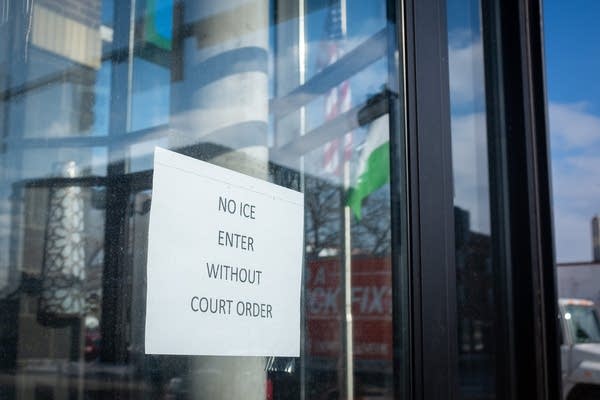
Professor William Lopez of the University of Michigan School of Public Health said “mass deportations” have become a hallmark of President Donald Trump’s second term, with agents trying to hit the goal cited by members of the administration of deporting a million people a year.
“There’s no way that ICE and Border Patrol would be able to find and specifically target 1 million people, they’re definitely counting on collateral arrests to reach that number,” Lopez said. “The way that they do that is absolutely through warrantless arrest or through racial profiling.”
While much of the ICE activity has been centered in the core cities of Minneapolis and St. Paul, it’s also spread to suburbs and small towns across the state.
Over the weekend, two men took refuge on a roof in Chanhassen in frigid temperatures in attempts to avoid ICE agents. One of the men, who were widely referred to online as roofers, was arrested and then hospitalized due to the cold. The other was not detained.
An ICE St. Paul spokesperson said in an emailed statement that agents were trying to arrest a man who pleaded guilty to domestic violence charges, but were deterred when “a crowd of agitators descended on our officers and disrupted the arrest.”
In an action on Dec. 6, ICE agents arrested the parents of a 7-year-old child in Burnsville. The child was left with a young woman whose husband had also been arrested. Arrests of Somali-Americans in cities like Rochester with large immigrant populations have also set off warning bells for some residents.
Challenges to tracking ICE arrests
When ICE makes an arrest, people say they’ve typically been brought to Whipple Federal Building for processing. Detainees can be sent to one of five facilities around the state that are contracting with ICE. In some cases, detainees may be sent unexpectedly out of state.
ICE hasn’t been releasing the exact number of arrests they’ve made or identified most of the people who have been arrested. The website detentionreports.com sweeps up information, which is updated every two weeks with data from ICE detention reports, and shows 181 non-criminal detainees in Minnesota facilities, meaning the people detained are not facing criminal charges but likely being held for alleged civil immigration violations.
MPR News has identified more than a dozen arrestees because they filed habeas corpus petitions in federal court arguing that their detentions are unlawful.
Around half of the petitioners are from Somalia. Most are asylum seekers who fear their lives will be threatened if sent back. One case involves a woman who has been under a removal order “to any country that will accept her” since 2012.
According to her attorneys, the fact that she’s been allowed to remain out of custody is an indication that ICE didn’t consider her a public safety threat.
She was arrested Dec. 4 “while driving to pick up a sick child from school and bring them home.”
The other half of petitioners hail from Latin American countries.
That includes one Ecuadorian national who has no criminal record and has been in the United States for more than two decades and who has children who are citizens, including one who is serving in the military. The man was recently transferred unexpectedly from a facility in Sherburne County to Texas.
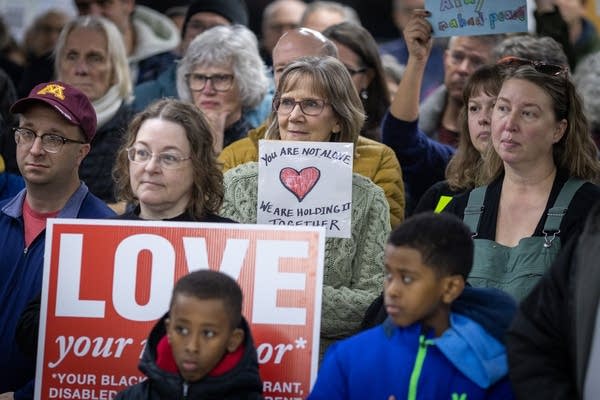
When detainees are far away, it’s also harder for them to keep in touch with their attorneys or family members. Lopez said these tactics can emotionally and economically pressure immigrants to agree to what the Trump administration calls “self-deportation.”
“Many detainees are immigrants who define themselves based on their ability to provide for their families, so it’s a particular type of cruelty to say, ‘We will give you due process, you just wait in detention and you’ll have your day in court in a few years,’” Lopez said. “Meanwhile, nobody’s there to pay for your family.”
Although news of some arrests trickles into public consciousness through a GoFundMe or social media post, Lopez said many family members are hesitant to speak out publicly due to their attorney’s advice or fears that other family members might be targeted.
Rising tensions between ICE and activists
Other cities like Los Angeles and Chicago that were targeted for immigration enforcement surges also experienced dramatic confrontations between observers and federal agents. Recent weeks have led to escalating use of force and chemical munitions by ICE agents when confronted by activists.
While activists around the country have adopted some general practices, including using whistles to alert neighbors and bystanders about the presence of ICE agents, Lopez said opposition to ICE has taken on its own life in each city.
Portland held jazzercise classes outside ICE headquarters, and other places adopted gospel music as part of their activism. In Minnesota, he expects the weather to play a role considering that ICE historically hasn’t been very active during the winter.
“In Minneapolis, what I would say is that when it comes to a battle of the cold, Minnesotans are going to beat anybody,” Lopez said. ”You don’t try to have a duel with them to see who’s going to stay outside longer.”
Lopez said recent court decisions allowing race and accent profiling imply that any people of color or foreign-born residents “must constantly prove their right to exist.” He said it’s notable that opposition to ICE activities in big cities seems to have transcended race, immigration status or political party.
“Everyone on U.S. soil wants the right to protection from unjust search and seizure,” Lopez said. “For that to be taken away, for you to be able to be questioned and pulled over at any time by roving patrols of border patrol, that isn’t the U.S. people want to live in.”
In other cities that experienced immigration enforcement surges, the number of arrests appears to have leveled off after a number of months. ICE and the U.S. Department of Homeland Security did not respond to questions about when the Twin Cities actions, which they’ve dubbed “Operation Metro Surge,” will end.


 English (US) ·