
ARTICLE AD BOX
It's another hazy week in Minnesota as wildfire smoke from Canada hangs over the state.
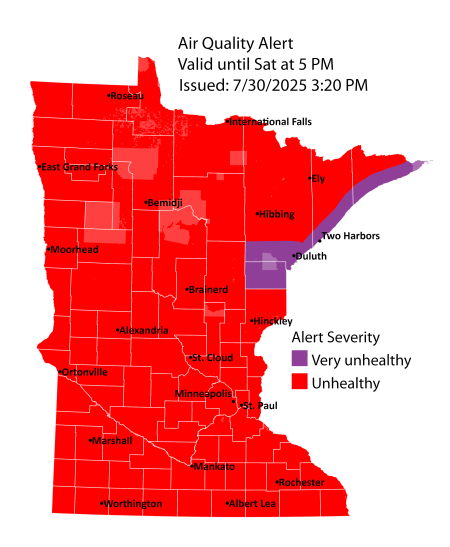
Conditions are unhealthy for everyone as of Thursday morning, and an air quality alert is in effect through Saturday evening. The Minnesota Pollution Control Agency recommends that people limit their time outdoors when the atmosphere is like this.
But what does prolonged exposure to wildfire smoke do to your health? Pulmonologist Dr. Andrew Stiehm, a doctor who specializes in lung function and disease at Allina Health, joined MPR News host Cathy Wurzer on Morning Edition to explain.
The following has been lightly edited for length and clarity. Listen to the conversation by clicking the player button above.
What’s happening to your lungs and heart when assaulted by wildfire smoke for days on end?
Needless to say, the lungs don't like it very much. When you inhale, particularly these finer particles like we see in smoke, they can enter even a deeper part of the lungs. And then they cause both a combination of inflammation for many people, as well as some allergic irritation for different people. And so then you see the lungs react to that. They can swell and they can spasm, which causes the symptoms we're probably familiar with of wheezing and cough, particularly in vulnerable people.
And then the heart and lungs very much work in tandem. And so whenever the lungs aren't working well, the heart sometimes tries to pick up the extra slack. And so you can start to see the heart work more than it's used to. And then some of these particles can enter the bloodstream and even impact the vascular supply, the blood vessels, and make those spasm and irritated as well, which is not good for the body either.
How fast do these health consequences kick in?
There's a combination of short-term and long-term problems. Like many people, when my family goes outside on a day like today, I've got one of my children who, within minutes, will start to have an irritated throat, runny nose, and you can start to hear them cough. And then I have another child who you probably can't even tell anything is going on. So in many ways, it really does depend on the person and their susceptibility.
The state provides some guidance, for instance, for child care centers. And on these days when the air quality index is above 150, even healthy people can be affected by poor air quality. And they recommend not being outdoors on days like today, when we're vulnerable and anyone could be irritated by the air quality.
We're seeing a lot of our chronic lung patients reporting that this has been a difficult summer, and they can feel more chest tightness, more wheezing in the hospital and in the ER, as we're seeing people with increased respiratory complaints, as well.
What kind of protection and prevention steps exist?
An N95 mask can protect you against some of the particles in the air. The problem can really be the fit, and keeping an N95 and mask tight on the face for extended periods of time can be kind of difficult, and then things can leak in through the side. But it would be helpful for some.
Shut the windows, use an air conditioner or air purifier — all are reasonable things to do. Roll up the windows on the car. Avoid using your car during the day, if you can, and minimize those trips so that we're not contributing extra to the poor air quality. Those are all things that we can do to help.
Check current air quality conditions and find more resources about staying healthy during days with poor air quality from the MPCA.


 English (US) ·