
ARTICLE AD BOX
In the last couple of years, at least a dozen data centers have been proposed across Minnesota.
These are the facilities that power artificial intelligence, store medical data and save your family photos to the cloud.
Data centers have promised jobs and investment in local communities, ranging from Twin Cities suburbs like Rosemount and Farmington to small rural towns like Cannon Falls and Hermantown.
But there are concerns about how they could impact the local electrical grid and water supply.
MPR News guest host Catharine Richert talks with her guests about the resources these centers use and what that means for Minnesota communities.
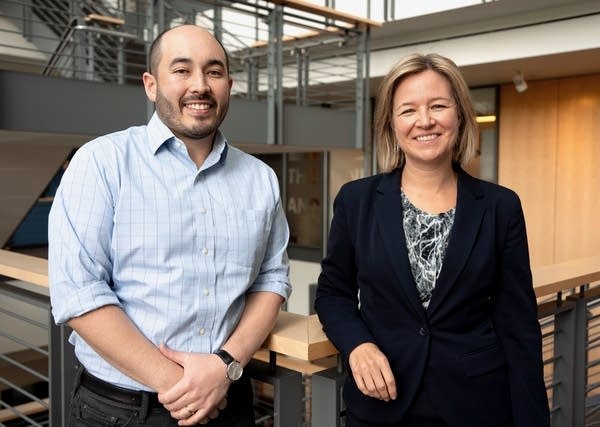
Guests:
Gabriel Chan is an associate professor at the University of Minnesota studying policy and institutions related to clean energy transitions and the environment. He’s also the co-director of the Center for Science, Technology and Environmental Policy and the Electric Cooperative Innovation Center at the University of Minnesota. He is also the vice chair of the board of directors of the Minnesota Center for Environmental Advocacy.
Kathryn Hoffman is the CEO of Minnesota Center for Environmental Advocacy. She leads a group of lawyers who take cases around the state to protect Minnesota’s environment. Currently her team has lawsuits against the cities of Faribault, Lakeville and North Mankato for a lack of transparency around data centers.
Subscribe to the MPR News with Angela Davis podcast on: Apple Podcasts, Spotify or RSS.
The following is a transcript of the conversation, edited for clarity and length. Listen to the full conversation by using the audio player at the top of the story.
Catharine Richert: Our topic today, Chris, is about data centers, and not the small ones that have been around for a while but these really big ones being built by the artificial intelligence industry. What are you seeing there in terms of how big these investments are?
Chris Farrel: So this is an incredible time in our history. I mean, you think about all the negative impacts that are weighing on the economy, and this AI boom, it's propping up the economy in the stock market. Venture capitalists, for example, invested nearly $200 billion this year. Data center investment, which you're going to be talking about, you know, has tripled since 2022. So despite tariffs, despite the shutdown, despite worries about inflation, despite concerns about the job market, AI investment is so strong that it is largely keeping the economy growing.
I'm sure you've noticed more and more columns, more and more discussions about, OK, is this a bubble? This AI bubble? And that's when investor enthusiasm just outruns reality that eventually bubbles pop. And there's some of the legendary finance stories: Mississippi bubble, the roaring 20s, the.com boom and bust.
And financial commentators are right when these wealth-creating bubbles end — boy, it destroys a lot of wealth. But the economic historians also point out that when you have these speculative fevers that emerge during intense periods of economic technological change, it accelerates the rise of a new economy or the spread of this new technology.
So there may be an AI bubble, there may not be an AI bubble. If it is a bubble, when it pops is uncertain. It could be three months. It could be a decade. No one knows.
Richert: Gabe, I want to start with you. We should make clear that the data centers that we're talking about today are the really big ones. Data centers have been around for awhile, you know, but we're talking about these large ones. What are they and what do they power exactly? And what makes them different from the data centers of the past?
Gabriel Chan: So these new data centers are big. This is the bottom line, is that they contain a ton of computational hardware to store data, to process this data, to route information across the country and the globe. They're the facilities that run our internet and run these new, complicated computational programs for AI models.
They require a lot of electricity, a lot of water, quite a bit of space … It's a lot more than our data centers of the past, which are helping us stream Netflix. These are doing much more complicated, computationally intense work and require a lot more space and hardware to do that.
Richert: We should just say, too, it's not just AI like ChatGPT, it's also cloud storage. It's for crypto. There are a lot of things that these data centers do for us that maybe we don't realize.
Kathryn, a facility is being built by Meta in Rosemount. That's the only known hyper-scale data center under construction right now in the state. But as I mentioned, many more have been proposed. Why are we seeing more data center proposals right now? And why are they interested in Minnesota?
Kathryn Hoffman: The companies that are proposing these data centers see Minnesota as a emerging market. And there's some parts of the country that are already pretty well saturated, honestly, with these facilities. Northern Virginia is one of them. Texas has quite a few, and they're running into limitations around resources, certainly electricity, but also potentially water.
And so they're looking for other places of the country to build them. So Minnesota has emerged as a place that's viewed as having plentiful water and also viewed as having favorable laws around clean energy, because we do have a goal in statute to be 100 percent carbon-free by 2040.
Richert: What is the Minnesota Center for Environmental Advocacy’s position on data centers?
Hoffman: Our position is that we need more transparency around these proposals. We need a better process. What we're seeing right now is a troubling trend of secrecy in the way that these projects move forward. In Minnesota, we have robust laws around environmental review. This is our Minnesota Environmental Policy Act, and it requires a study before we move ahead with projects. There's a national version of this people may have heard of — it's called NEPA. We also have one in Minnesota called MEPA, and it's often referred to as the “look before you leap” law. Let's study it. We'll understand the impacts. We'll understand if there are alternatives that are better, if there's mitigation measures that are available to lessen the environmental impacts before we start building a facility.
But the data centers are moving forward without going through that robust environmental review process, so we don't really know what the impacts are of these facilities. And we also aren't seeing an opportunity for public engagement. The public comment period is very limited, whereas really what we should be seeing is an opportunity for residents to understand what's being proposed, what the potential impacts are and to talk to their elected officials about their concerns or questions about that.
Richert: You guys are going to court over these data centers. What are you contesting, exactly? And most recently, last Friday, you filed a lawsuit against the city of Pine Island — which is in my neck of the woods — over one that's being proposed there. So what's the meat of these arguments you're making?
Hoffman: The meat is that these facilities, or the studies that are being done on these facilities, don't meet the requirements of the Minnesota Environmental Policy Act or MEPA. And so MEPA has some baseline requirements. You have to specify what is it that you're proposing.
In Lakeville and in North Mankato, they don't ever use the word data center. It's actually not even clear what's being proposed.
Richert: What words do they use?
Hoffman: Oh they might say technology office park or industrial facility. What they're saying is, “Well, we don't have a committed data center at this location,” but it's clear that data centers are being contemplated and that the impacts aren't being analyzed. So, first of all, we're not really even specifying what it is.
Now in Faribault and Pine Island, they did say this is a data center. So that’s something, but that's only the beginning of what our environmental laws require. You also have to actually analyze the impacts. So you have to say: Here's how much water is being used, and here's how that would affect other users nearby, other cities that are pulling from the same aquifer. Here's how it would affect private wells nearby, who might see the aquifer depleted and then have problems with their private wells. Here's how this might affect the aquifer in 10 years or 20 years, as climate change creates more drought. You have to analyze the electricity pull, and what does that mean in terms of, do we have to build new facilities, new electricity generating facilities, new infrastructure? Will that drive up people's electricity costs?
You also have to analyze local impacts, like noise. These facilities generate a noise that neighbors will often complain about. Sometimes they're lit 24/7, so there's real quality of life impacts for people nearby. Environmental review is designed to look at all of this.
And if you look at these documents that are coming out of these cities, they're really just empty vessels. There's no information at all about any of these things, which means that the public doesn't have the information they need to engage, and officials really don't have the information they need to make decisions.
Richert: Gabe, Kathryn said we don't know exactly how much water or electricity these places are using; but is there anything we can learn from other states that are further along in data center construction and usage in terms of the resources they're using?
Chan: I think from other states, we're seeing the pace of change, and there's a lot of really important questions about, how do we plan the infrastructure around these facilities to be able to accommodate their really significant resource requirements? We're seeing states like northern Virginia — where we're seeing a lot of development there — and the Virginia electric regulators have to figure out how to ensure that the data centers are paying their fair share for their electricity consumption.
We're seeing in other places, including in the Midwest, places like Ohio and Indiana, where these data centers are being proposed; and then, if they don't actually get developed, how to handle the costs of the site preparation. The grid preparation for this becomes a real challenge for the community that continues to live there and continues to rely on the electric grid that has now had to handle a very significant amount of investment to get ready for a data center that might not ever come. And so I think there are really important roles for the state and for local governments to make sure that if there is a proposed data center in the community, that the concerns of the folks who continue to live and work there are really factored in that decision.
Richert: We've seen people sharing on social media here in Minnesota that data centers could lead to a local power grid failure, maybe higher electricity rates. Is any of this accurate?
Chan: I think the concern about electric rates is really important. A lot of our electricity rate setting happens at the state level, and so in Minnesota, our Public Utilities Commission has a really critical role in making sure that data centers pay their fair share.
This is not an easy question, because the way that regulators think about affordability of rates is really based upon how much infrastructure has to get built to serve our electric demand. And for the last three or four decades, electric demand really hasn't been growing.
We've been thinking about how to prepare for electric vehicles and electric space heating. A lot of that is still in the future, though. And so we've been doing a lot of work to update our regulatory frameworks for this new environment of increasing load growth for the first time in three or four decades, but we hadn't really gotten there until these data centers have really started to drive electricity demand.
And so I think the framework for how to make sure the data centers pay their fair share is super important, but we don't have a lot of playbooks. In particular, the hardest part is when a data center gets proposed, the infrastructure starts to get developed and then the data center doesn't come. And how to allocate those costs to make sure that electric rates stay affordable is something that I don't think we figured out yet.
Richert: Kathryn, you mentioned earlier that sometimes when these data centers are proposed, it's not entirely clear what they're there for. When I hear technology park, I feel like my brain could plug in any number of things into what what's going to be there. Is that by design, or is that just sort of a feature of how these these centers are developed?
Hoffman: It is by design. You know, one of the things we haven't talked about that I think is important to know about the way that these proposals are proceeding is that often the project proposers ask city officials to sign nondisclosure agreements. So these are agreements that say the city officials will not talk publicly about what the proposal is.
I mean, we don't know for sure, but it appears, for example, in Lakeville and in North Mankato, those applied. And so, when the city went to do environmental review, they couldn't say data center, because that would be a violation of their nondisclosure agreement.
For Hermantown, we recently discovered it has a series of interlocking nondisclosure agreements for various city public county entities in order to ensure that a lot of officials knew that this was a data center and the public did not, and some of those date back over a year. So this has been happening for awhile. Our organization, the Minnesota Center for Environmental Advocacy, put in a request for public documents, and these NDAs are considered public documents under state law. Back in May, and all through the summer, they were nonresponsive. They kept telling us, “We don't have them yet. We don't have them yet.”
Finally, we got the documents in September, and that's when the public and how the public learned that this was a data center being proposed in Hermantown. And so we have this lack of transparency because of these nondisclosure agreements.
I think that tech companies would say, “Well, we have an interest in keeping this information from our competitors.” Maybe Meta met a doesn't want Google to know where they're proposing their data centers. And that's fine. But we as Minnesotans can weigh that against the public interest in terms of transparency and what we expect from our government officials for transparency. And I think that bar is clearly not being met, and you see a lot of residents who are upset, yes, about the data center, but perhaps even more so, about the about the secrecy.
Richert: Gabe … there's a perceived or actual economic benefit here: jobs, wider tax base. What do we know from other communities that have built these centers in terms of how it contributes to the economy?
Chan: I think that there is incredible potential. We have some of the world's most wealthy companies coming and proposing investments in our state in projects that will create a lot of construction jobs in particular. You know, I think in the recent legislation Minnesota passed, prevailing wage for those construction jobs was achieved, and I think that's a really important component to it.
But I think also, we should remember that these are the world's wealthiest companies, and when they come here, that their investments should really impact positively the communities. And I think there's a lot of strategies and communities can ask for a lot of things in the public engagement process that the previous callers referenced.
I think knowing what to ask for is a really important piece of the puzzle that local governments can help drive. I think that we can also see, how do we link all of this infrastructure development, not just to meet the goals of the tech companies but also to meet the goals of the community and the state? We have a lot of need for new infrastructure development. Our grid has seen significant under-investment over many decades. We need a lot of help moving capital to electrify heating and transportation to meet our state's climate goals.
How can we leverage this opportunity that these tech companies are bringing with their big investments to meet some of the goals that are long standing in the communities and the goals that we need to achieve for affordable and reliable electricity moving forward?
Richert: Kathryn, I want to go back to the question of water and water usage. We know that these data centers can use a lot of water. What do we know exactly about how much water it takes to cool these systems down? And will being close to a data center affect someone's water quality?
Hoffman: The issue with these big data centers is that they produce a lot of heat. I mean, you can imagine, maybe you've sat with your laptop on your lap, and it starts to get warm. So imagine that, you know, exponentially larger, so they need to be cooled on a continuous basis. At a base level, you can cool a facility using water, or you can cool it using air conditioning, and those things sort of trade off. So if you use less water, you'll need more electricity, because you'll need more air conditioning. If you use more air conditioning, you might need less water.
With these facilities, we see a wide range of water uses. You may see some that don't use very much water in places like the southwest, where water is quite scarce. They may be using more air conditioning, or they may be using liquid coolant strategies. So there are some strategies available that don't use a lot of water.
In general, these companies are — they look at Minnesota, and they think of us as a water-rich place. And you know, we are, in a sense, obviously; we have our 10,000 lakes or more. We have abundant water resources.
But our water resources are not infinite, and already, especially in the areas where these projects are being proposed — sort of the outer-ring suburbs — those groundwater aquifers are under stress because those cities are growing. You might have multiple cities drawing from the same aquifer. You also have folks on private wells who are drawing from those aquifers as well. And those aquifers can become depleted over time, and then, as a result, cities may need to dig deeper wells. People may need to dig deeper wells for their residents. We may need to ultimately ration water.
Some of that's already happening in Minnesota, and so when you look at some of these proposals, for example, the one in Farmington is talking about up to 2 million gallons of water per day. That's a lot of water. That's as much as the entire city of Farmington uses right now. It would double their usage. Essentially, that's we really need to ask the question, what will that do to the aquifer? What will that do to neighboring cities who are also drawing from the same aquifer? Do those neighboring cities also have data center proposals that will massively increase their demand? What about the private wells? We need to do that analysis before we sort of dive head-first into allowing these facilities to use huge amounts of water.
The other thing I want to mention real quick is: we do have a hierarchy in Minnesota statute over water uses. And we put municipal uses at the top. Right? Homes and businesses. And what these data centers are doing is they want to go under the city's permit.
So if you want to take water from an aquifer, you have to get a permit from the Department of Natural Resources. And so the city of Farmington has a permit, and if they are going to service this data center, they're going to need to go get a much larger permit, you know, twice as much water, in order for that to work. They might also need to drill some new high capacity wells, etc. And when they do that, if there was a time of scarcity, and we did have to do some rationing, municipal is the highest use. So those data centers get into that highest use of municipal, which is above, for example, agriculture.
And so we are sort of, by default, allowing data centers to become among the highest priority uses in Minnesota, which I think is something we should be talking about. And I think there's a pretty strong argument that these facilities should actually be required to get their own permits with their own status that's separate from municipal. And we can talk about, you know, where are these facilities in the hierarchy, and how do we want to handle them in the event that there's competition?
Listen to the full conversation by using the audio player at the top of the story.
Correction (Oct. 23, 2025): A previous version of this story did not identify Gabriel Chan as vice chair of the board of directors of the Minnesota Center for Environmental Advocacy.




 English (US) ·