
ARTICLE AD BOX
President Donald Trump called for the “immediate end” of temporary protected status of Somali people in Minnesota on Friday, prompting questions about whether he could take the step alone and what could happen to hundreds of people in the United States under that designation.
Some Minnesota leaders celebrated the move, saying it could force accountability after dozens of people were charged with defrauding state programs. Meanwhile, Somali community leaders and DFL officials said the move cast an entire community as bad actors and could endanger people’s lives.
As debate plays out about the program’s future, here’s what you need to know.
What is temporary protected status?
Temporary protected status, often referred to as TPS, is a federal designation that allows people from other countries to remain in the United States and pursue work and travel authorization if they come from a place experiencing armed conflict, environmental disasters or other extraordinary conditions.
The Department of Homeland Security decides which countries are designated as TPS-eligble.
There is no path to citizenship from temporary protected status. It is a self-contained status from which there is no other place to go unless there is a substantive change in a person’s circumstances, such as marriage to a permanent resident or citizen, or if someone is eligible for other immigration protection.
How many Somali people have it?
Across the country, there are 705 Somali migrants with temporary protected status, per a congressional report issued earlier this year. Hundreds of those are in Minnesota. But far more — tens of thousands of Somali Minnesotans — are legal residents.
Does the president have the authority to end the program?
Legal officials say it’s outside of the president’s authority to end the program. Somalia was first added as a temporary protected status-designated country in 1991 after civil war broke out there. That status has been extended more than two dozen times as U.S. officials found that it was too dangerous for Somali people in the United States to return to Somalia. And the latest extension is set to run through March.
Alec Shaw, civil rights attorney for the Council of American-Islamic Relations, Minnesota, said the president’s social media announcement on Friday “has no legal effect.”
TPS programs can only be terminated by the Secretary of Homeland Security, Shaw said.
On Sunday, Homeland Security Secretary Kristi Noem said federal officials would assess whether Somalia should remain on the list of designated countries, suggesting Somali people in Minnesota wouldn’t be affected right away.
The Trump administration has sought to roll back temporary protected status for migrants from other countries, too. Hundreds of thousands of people in the U.S. from Venezuela and Haiti who had temporary protected status have been affected.
Why does Trump want to end the program for Somali people in Minnesota?
On Friday, Trump deemed Minnesota a “hub of fraudulent money laundering activity” in a post on Truth Social. And he alleged without providing specifics that Somali gangs were terrorizing Minnesota.
So far, dozens of people in Minnesota have been charged in connection with a scheme to defraud a COVID-19 era child nutrition program. That was largely through the nonprofit group Feeding Our Future. Federal officials have also charged others for alleged misuse of state programs intended to provide autism treatment and housing stabilization services.
Some of the people charged and convicted in those cases came to Minnesota from Somalia. Though it’s not clear that any of them are on temporary protected status.
How are Minnesota officials responding?
Many Minnesota Republicans celebrated the move on social media channels. House Majority Whip Tom Emmer, a Republican from Minnesota, thanked Trump for his call to end the program.
“Accountability is coming,” Emmer said in a post on X. Emmer also penned a letter to the U.S. Attorney for Minnesota urging an investigation into whether state funds that were misused ended up in the hands of terrorist organizations.
Republicans in the state Legislature made a similar request for an investigation on Monday.
Somali community leaders and DFL lawmakers said the move was misguided and could put Somali people in danger. Dozens gathered in the Capitol rotunda on Monday to stand in solidarity with Somali people in Minnesota.
“That language is dangerous, that language puts the lives of Somalis, not only in Minnesota but across the country, in danger,” U.S. Rep. Ilhan Omar said. “And if the President believed that, and he had evidence, he would take people to court.”
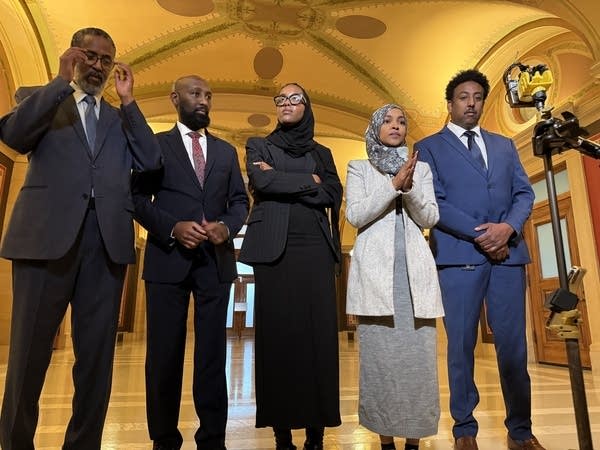
Omar and other Somali elected officials condemned fraud in state programs. And they said that the Somali community shouldn’t be blamed for the actions of some individuals.
“In this country, we do not blame the lawlessness of an individual on a whole community,” she said. “If you believe in law and order, you understand that if a person commits a crime, they face justice, and that you don't put that crime on a whole community.”
Julia Decker, policy director for the Immigrant Law Center said the prospect of leaving creates uncertainty for families who have been in the U.S. for decades under TPS.
“Many people have created very deep roots in the United States, so it creates sort of a very serious rupture,” Decker told Minnesota Now guest host Chris Farrell.
Will Minnesota officials intervene?
Attorney General Keith Ellison said Trump didn’t have the authority to terminate the program for people in one state.
“The Trump administration wants to claim that Somalia is too dangerous for anyone to visit, but perfectly safe to return TPS holders to return to this is obviously absurd, obviously political, obviously wrong,” Ellison said. “My office is looking at every option on the table to push back against this threat.”
He said efforts to terminate temporary protected status for other countries during Trump's first term succeeded. And others are working through the courts now.


 English (US) ·